11/1/09

currently under construction

SPEECH IS CURRENTLY UNDER CONSTRUCTION

the archive is available to be viewed but most recent posts are incomplete

9/14/09

Chris Kraus with Martin Rumsby


Chris Kraus: The present moment always radicalises everything... I wanted everything to be current, contemporary, right now, even when looking at history.

Martin Rumsby: Paul Thek, an artist who was celebrated, he left America, was shown in Europe... was catalogued, but the work was bulky, it became inconvenient, the places that supported it destroyed his work when they were trusted to look after it and then he was written out of art history and no longer exists. That's an important story: the way art history is constructed.

Chris Kraus: That's the real story, being that there is no such thing as something that is objectively great or objectively monumental or objectively worthwhile. All of that occurs by consensus, what the culture believes at that moment is important.

5/9/09

Anastasia Klose with Natalie King

Tolarno_Klose_1
The Happy Artist
Tolarno Galleries, Melbourne
19 March – 18 April

Natalie King: Can you tell me about the title of your recent exhibition The Happy Artist at Tolarno Galleries in Melbourne?

Anastasia Klose: The title The Happy Artist leapt into my head one day while at the office, and I couldn't get rid of it. To me, it's the perfect title for the exhibition, because it has so many different interpretations. At first glance, you might think it was an ironic title, as a lot of my subject matter is about petty grievances in life and struggling on and that sort of thing. But in fact the title is not ironic, because being an artist is actually the happiest thing I could be. Self expression and creating things and constructing my own world are a very liberating thing to do. I love the notion that in our culture, "artists" more than anyone else are permitted to be the most themselves, and the most 'extreme'.
read the interview

1/11/09

Wendy Saddington

12/3/08

Patrik Andiné

Patrik-Andine
Angelika Knäpper Gallery
Stockholm, Sweden
Nov-Dec 2008

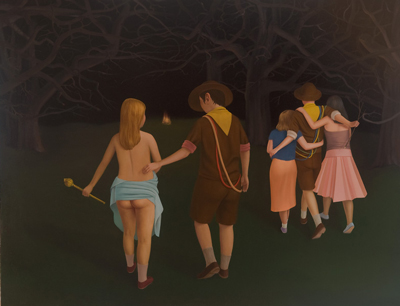
Patrik Andiné is an artist typical both of his time, generation and geographical location. He is northern European (could be American), male, mid-career, he uses traditional media and excels in the execution of his work. He is obsessive and introverted. But the true trademark of these artists is that they refuse to grow up, obsessed with their own adolescence. All references in the artwork goes back to what the artist lived in this period of his life, describing a total freedom that has been lived in the moment between childhood and adulthood. The young artist lived in the womb of his family and yet he could live in total liberty: taking drugs, exploring casual sex and enjoying music. In short he was formulating who he was to become as an adult. Not only that, but when he woke up hung-over his mother spoiled him and cooked him lavish meals. He lived both the adventure and security - what bliss! But to take the step out of this personal utopia and become an adult, seems to be virtually impossible. To these men, growing up is the biggest threat to that world and is connected with an abysmal fear.

And yet Patrik Andiné’s art has something that beckons our curiosity and sets him apart from the rest. Even though his work is slightly contrived, narcissistic and displays the same trademark mixture of surrealism, fairy tale imagery and popular culture references as his peers, there is a profound difference. He happily agrees that his images are the psychoanalyst’s wet dream. He admits that his world of voyeurism (the child finding out that his parents are sexual beings – ouch!), scout outings (the child finding out that other children are just like him – ouch!) and self-portraits (looking yourself in the mirror and accepting who you are –ouch!) is the absolute opposite of what it gives itself out to be. It is not surreal at all. It is the most ordinary and mundane experience that we can possibly live. It is disguised in the clothes of surreal or the supernatural, because to a child the world is totally incomprehensible. But this is also the reason why the images are so invasive.

Andiné tries to break free from the world that he is enslaved in and that is what sets him apart from his peers. He is looking for a liberty that goes beyond that of the teenager. He tries with all his might to become an adult. His entire artistic oeuvre (and probably his life) is devoted to this struggle. His paintings are unlike most paintings in this world not finished and that endows them with a profound power. They are the testimony of very real wars that he is waging, both on the inside and against the world and his cultural context. They show a man engaged in the process of changing his life. But he does so without going against his own nature. It is here that the work displays how brave he is and also the immense risk that he takes in his work. Despite their conservative appearance and obsessive execution, Andiné’s paintings are one of the few things that are alive in the mental, cultural and human permafrost of the cold north. He is such a contradictory thing as a Swedish rebel. Even when (or maybe because) his paintings depict a masturbatory world, they fight back and refuse to accept the social stereotype that surrounds them.
Per Hüttner

11/28/08

Pierre Leguillon

pierre-legebay
"Une exposition d'oeuvres d'art contemporain en vente sur Ebay"

La spéculation intellectuelle que l'on fait sur les oeuvres d'art peut-elle se mesurer à la spéculation marchande des objets mis en vente sur Ebay ? Revenons sur une expérience osée par Pierre Leguillon lors de la vente qu'il organisa sur Ebay de la totalité des pièces montrées dans l'exposition "Le dernier qui parle" présentée en début d'année au Frac Champagne Ardenne.

La particularité de l'ensemble de la collection présentée comme telle est d'être une sélection de documents pour la plupart imprimés et recoltés par l'artiste comme autant de pièces d'un puzzle lui permettant de donner une réflexion sur le statut de l'oeuvre d'art et d'en éprouver ses limites. Si la coïncidence et le traitement par analogie est souvent un mode opératoire que Leguillon utilise pour faire émerger le sens de ses oeuvres, ici, c'est clairement le contenu documentaire de la collection mis en vente qui renvoyait à la nature des pièces qu'il est possible d'acheter couramment sur Ebay : cartes postales, pages de publicité vintage, photographies de cinéma, gravures ou estampes et une sélection de pièces plus rares parfois telle qu'une lettre que lui a adressé Douglas Gordon.

Ce n'est pas sans coïncidence non plus si l'artiste a rediffusé les pièces qu'il a chiné sur Ebay augmentées parfois de dix fois leur valeur courante (indiquée en prix de réserve) puisqu'elles deviennent les pièces constitutives de cette démarche inlassablement référentielle dont la preuve était fournie par un certificat remis à l'achat et portant la mention spéciale "ancienne collection Pierre Leguillon".

Il n'y a donc pas de doute sur la nature artistique de ce geste, flirtant avec les réseaux de diffusion parallèles, et revendiquant une place volontairement en marge des systèmes légitimant actuels du marché de l'art établis par les galeries. Notons, toutefois, que la galerie "Air de Paris" a accepté d'organiser la vente tout en se portant caution auprès des acheteurs potentiels.

On mesure parfaitement le désir omniprésent qui l'anime de contrôler les modes de diffusion de ses productions et d'assumer comme une démarche la promotion de son travail, à l'image de l'homme sandwich qu'il a fréquemment utilisé dans ses associations d'images. Même s'il ne nous échappe pas que ce geste peut être aussi celui d'une solution trouvée pour répondre à un besoin de subsistance teinté de désillusion.

Il faut, cependant, reconnaître le courage de la tentative et les risques encourus pour son image en cas d'échec de l'opération.Un bon relais de communication par mail a été assuré conjointement par la galerie et l'artiste qui avait également prit soin de réaliser un catalogue de vente très renseigné sur les pièces disponibles. Une sélection d'oeuvres était disponible à la galerie et présentée sur l'un des murs.
Pourtant, le résultat des ventes est resté assez mitigé. Beaucoup d'enchérisseurs ont misé sur l'ensemble des pièces, mais très peu de ventes effectives ont abouti en partie pour les mêmes raison qui justifient la qualité et le sens de son travail : de forts prix de réserve qui ont sans doute essoufflés les parieurs, et la distance de l'anonymat qui ne facilite pas la communication sur les oeuvres.

Comme toute expérience artistique qui requiert la participation du public pour fonctionner, elle se limite souvent à une activation plutôt exceptionnelle et confirme que la tentative de l'artiste pour contrer un système exclusif de reconnaissance par le marché, n'a pas infléchi l'engagement des collectionneurs, ni contrer leurs habitudes d'achat. Celles qui consistent à valider et soutenir le choix d'un galeriste parfois plus qu'à s'engager pour le travail d'un artiste isolé.
Sophie Auger

7/28/08

The Telepathy Project

Telepathic-Project
Veronica Kent and Sean Peoples
Next Wave Festival
Forum Theatre Melbourne, 20-24 May 2008
& Poster Note Publication launch
Sticky Institute, Degraves Subway Melbourne, 19 July 2008

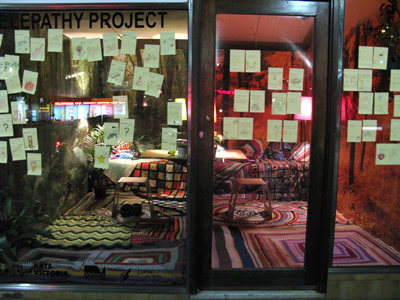
In May the Next Wave Festival hit Melbourne at its usual break neck speed. Situated on the corner of Flinders and Russell Streets in a south-facing window of the Forum theatre, Veronica Kent and Sean Peoples’ Telepathy Project provided a moment for pause not only within the festival itself but peak hour traffic in Melbourne’s CBD. Kent and Peoples divided the rarely used space into two self-contained rooms, wallpapered with photo-landscapes of rainforest and autumn forests respectively, the crochet blankets covering both floors and décor of each room colour-coordinated accordingly.

For four and a half hours a day, over a five-day period Kent and Peoples occupied the two separate rooms, completely isolated from each other but in full view of the general public. Every 15 minutes the artists would attempt to communicate with each other telepathically. Then rising from prone positions, stretched out on the floor or lying on their daybeds, they sat at identical sets of Ikea table and stool to document these transactions. The drawn results on oversized yellow post-it notes were time-coded, dated, labelled sent and received and stuck onto the window for us to see.

Kent and Peoples’ ongoing telepathic collaborations with signature New Age hippie meets psychedelic arts and crafts aesthetic are resolved without appearing laboured. The delivery of performative works, requiring commitment and lengthy periods of endurance, grounds their practice in a 1960s and 70s tradition of collaborative performance, like duos Marina Abramovic and Ulay or more recently Smith/Stewart. Although their telepathic communications rarely hit the mark, like the drawings of a monkey with a smoke versus an unpeeled banana, the beauty and humour lies in the close calls of the results and the attempt itself.

The Telepathy Project is documented in Poster Note Publication, a self-published compilation of telepathic 'post-it note' drawings made during the telepathic performance.
Meredith Turnbull

7/18/08

Drawing A Conclusion

Lacy-show-001
Hell Gallery, 5A Railway Place, Richmond, June–July 2008
Ernesto Burgos, Nadine Christensen, Matthew Delege, Anthony Farrell, Torben Giehler, Lily Hibberd, Chris LG Hill, Heidi Linck, Nick Mangan, Rob Mchaffie, Ola Vasiljeva, Gabriella Mangano & Silvana Mangano, curated By Danny Lacy

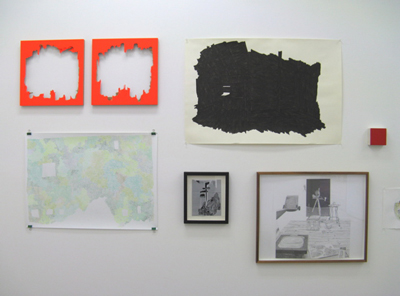
This small, neat show of interesting work seems like just the thing to capture something of a common thread in current art practices. At the same time, there’s something strange about the way it successfully registers this without any exaggerated curatorial statement or other pretence. Strange in the sense that it’s a business-as-usual kind of exhibition, but without any of the awkwardness or amateurism that you come to expect of emerging art related activity, even your own.

As for the work, post-formalist patterning in thin lines of fun-but-muted colours, muddy off-red and off-yellow monochromes, slow detailed pencil drawings, and watercolours of sticks and rocks and aristocratic children are represented. Then there’s bits of text – graffiti sampled in landscapes or song lyrics – and black and white pen drawings in a comic book style, and in general a lot of blank paper. Two sculptures, squashed-face doll with a leg in plaster cast, and a monochrome which doubles as a bench complete the show.

Apart from the expected variety and style of the selection, even the title seems to hint at cultural context in a slightly procedural way. It might go something like: ‘these works are testimony to continuation of the practice of “drawing” – now a euphemism for experimentation – with and against past forms and subjects, regardless of a generalised pathos at the end of modernity.’ Whatever it may really refer to, the presentation of a cool selection of works with a serious lack of affect seems to be the real intention. This professionalism is all the more noticeable at Hell Gallery, a ramshackle peter-pan house by the train tracks, with a perfect little white cube for a heart.
Michael Ascroft
Lacy-show-002

Robert Storr, Keynote Lecture

Biennales in Dialogue Forum
Museum of Contemporary Art, Sydney
11 July 2008

On the one hand, this talk was an introduction to Storr’s curatorial method and an argument for ‘dialogue’, and in general about the practice of curating biennales. On the other, it was another episode in the ongoing public debate between Storr and critics of the 2007 Venice Biennale he curated – in particular Okwui Enwezor who was also there on the night. This meant that nearly everything Storr said couldn’t help sounding like it had a vindictive tone, even though it was delivered in the professional, neutral language of academia – and in the end it really did turn into an exercise in personal and professional restraint gone wrong.

Storr wanted to use the idea of dialogue to discuss the experience of audiences, especially the non-specialist art audiences, and contemporary art; to discuss exchanges between artists; to show how this also relates to the ‘aura’ of an artwork; and how it is finally a political moment in which two or more antagonistic parties may find some common ground through the unpredictability of exchange. His big claim is that dialogue, in the context of biennales, is a fundamentally democratic experience in a globalised world.

For a start, biennales attract large numbers of the non-specialist public, and artists often get to meet one another at them. Walter Benjamin’s idea of ‘aura’ is that it is the result of an encounter of a viewer and artwork in a specific place and time; it is a personal experience but at the same time a social one. This means that ‘aura’ is made in a dialogic setting, again, provided by the biennale. But the political meaning of dialogue was not much more concrete than the example of a potentially beneficial meeting between socially conservative groups and provocative artists and/or curators. Maybe it was this political weakness of the talk that added fuel to the fire in Storr’s tirade during question time, which was aimed at Enwezor’s highly politicised talk of a couple days previous. Enwezor himself responded that Storr had repudiated everything he just said, and from there they both tried talking over the top of one another until Elizabeth Ann Macgregor, taking the microphone, asked them to continue the ‘dialogue’ outside.
Michael Ascroft
see Natalie King's interview with Carolyn Chrystov-Bakargiev
and on the theme of the Sydney Biennale
http://www.themonthly.com.au/tm/node/1065

7/1/08

Kate Smith

smith
Whoops Kibbutz, Utopian Slumps
25 Easey Street Collingwood, May – June 2008

Whoops Kibbutz, Kate Smiths’ first solo exhibition in Melbourne is loosely based on her recent experiences on the family farm — which I’m guessing is like staying at Mike Brown’s house while Urs Fischer plucks chickens and Sean Landers makes mix tapes in the barn. It’s a sprawling refined mess of text and paint, rollicking about like oversized party favours strewn out for examination, destroyed, renamed and hastily rebuilt for another whirl. The 30–odd works are littered with Smith’s signature meditations on art ‘practice’, and the environment at large — which could be the studio, as singular works imply — yet en masse the works seem to heave with a kind of fever. The kind of fever that comes with wanting to make to see an idea, throw things together to see if they work while the mind prickles and fingers twinkle. No question what a weekend away can do for the soul.
Geoff Newton

5/24/08

How free

There is no comentary for this post, only comments. Click on comments link below.
free
sam-henson

5/23/08

Ai Weiwei

ai-conversation
Ai Weiwei: Under Construction
Campbelltown Art Centre NSW, May-June 2008
curated by Dr Charles Merewether

I felt like Bart Simpson with a swimming pool of spit, a bandaid and a clump of dog-hair on my hand after I shook it with Ai Weiwei’s. (I told James and Hao that I wouldn’t wash it for a week, but I washed it that night back at the motel. Extremes that are easy in cartoons don’t translate so well back to life.) Having spent so much time in thinking and writing about Ai and what he does, and then coming face to face with them, there was a great imbalance, or inequality, so there was nothing to say. I told him I felt like I knew him; he told me he liked my dress, and then the natural thing was to move on.

(Later, an awkward but sincere government minister got up and spoke about being honoured and blessed to be in his presence: yes!)
click here to continue reading Liv Barrett's response

5/11/08

Brendan Huntley

Huntley2
In Order of Appearance, Utopian Slumps
25 Easey Street Collingwood, April – May 2008

Brendan Huntley. I love the band he fronts: Eddy Current Suppression Ring. Their songs are blunt and infectious. Likable guys. They sing about real stuff. ATMs. The weather. Walking. Square pegs in round holes. Clever dumb. I was worried about seeing Brendan’s art and not liking it. If his art was bad then the band might be tainted for me.

Art and Music. The two have an uneasy relationship. It’s not all flirting and friendly like the actor/model/doctor/nurse prototype. People dip their toes in the other’s pool but there’s no skinny-dipping wrestling fun. It’s more slippy-snidey than slippy-slidey. Artists secretly want to be in a rock band but the band doesn’t give much credo to being an art star. Artists feel they tread the artistic higher ground but go unappreciated by the greater public. So when musicians put their art up in galleries they can play easy targets. The art crowd take paltry pot shots and enjoy it. Stick to your day job. Stay out of our pool.

But really, what would a rocker want with the artworld? Partying in a white cube of a room under blinding fluorescent lights. Peering at painted foam turds sitting on plinths, just begging to be made fun of. Punters used to rowdy gigs and comfy pubs don’t really get the art-opening thing. Understandably. Art openings are hard work. Give me a good gig any day and yet I keep going to galleries to be uncomfortable and baffled. I’m looking for good art, dammit…

But I digress. I shouldn’t have worried. Brendan’s got his feet placed firmly in both camps. What I like about the music was solidly there in his art. Bright. Blocky. Warped fun. Clever dumb objects. Ceramic masks and balaclavas. A wall of painted doodly heads. At his previous show I loved and bought a ceramic paint tube squeezing out a fried egg. An artist friend said, “Oh that must be a play on egg tempera medium!” I prefer to think he had eggs for breakfast then went to his studio to rock some pots. Simple. As. That.
Jess Johnson

4/29/08

Carolyn Christov-Bakargiev with Natalie King

MOFFATT_MarieCurie.
16th Biennale of Sydney, Revolutions – Forms That Turn
17 June – 7 September
Interview with Artistic Director, Carolyn Christov-Bakargiev

NK: The notion of ‘revolution’ has clear political overtones – how are you engaging with local politics especially our recent change in government and momentous ‘apology’ to the Aboriginal Stolen Generation?

CCB: I’m very fortunate and lucky to be able to do a Biennale at the time of this recent change in Government in Australia, and honoured to be doing it at the time of this momentous apology to the Aboriginal ‘Stolen Generation’. I think it was overdue and is an important moment for Australian history. Of course an apology has to be followed by real events, but it is a step in the right direction. I think the issues with the relationship between western colonisers and their descendents on the one hand and the Aboriginal people here on the other is a huge question. I see a great poverty which is not right, and I see the wonderful positive nature of the introduction of Aboriginal art made today in the field of contemporary art in museums. However I also see the sweatshops and the great market increase of values that these paintings have (without any resale rights going back to the communities from which they emerged), so I see many problems. I think part of the wealth of Australia is the mines and I don’t see the money going back to the Aboriginal people, who are the traditional owners of the land. I’m shocked to find that in this country there are no rich Aboriginal people... read the interview
Tracey Moffatt Marie Curie 2005, from Under the Sign of Scorpio, a series of 40 images, archival pigment ink on acid-free rag paper, 43.2 x 58.4 cm, edition of 21

4/24/08

NEW08

Chris-Bond-2
Australian Centre for Contemporary Art
111 Sturt Street Melbourne, March – May 2008
Daniel Argyle, Matt Hinkley, Sandra Selig, Chris Bond, Gabrielle de Vietri, Paul Knight, Jonathan Jones, curated by Anna MacDonald

Do ACCA’s annual NEW shows act as a “stepping-stone on the road to career success” for artists? It’s unlikely that ACCA is set up to provide for an emerging artist in a meaningful way, as an artist-run initiative, project space or a committed commercial gallery may do by providing an ongoing venue or network of support and opportunity. What NEW does do is commission a one-off work of “scale and ambition” from selected artists. Needless to say, the show is subject to a great deal of expectation and hype, although NEW08 seems to have passed so far with less fanfare or review than usual.

Seven artists are included in the un-themed show, this year curated in-house by Anna MacDonald. The best are those who succeed in creating cohesive solo shows within the larger exhibition. Paul Knight, Matt Hinkley and Chris Bond each simply exhibit great works representative of their ongoing practices. Rather than showing off a body of work, David Argyle, Sandra Selig and Jonathan Jones contribute more singular works that are not necessarily amongst their best and at times struggle to gain traction in ACCA’s cavernous main hall. Gabrielle de Vietri’s series of interactive and performative works attempt to engage, recalling aspects of several recent ACCA exhibitions, including Gillian Wearing (the sincere admissions and personal exposures), A Constructed World (the singing and dancing) and Anastasia Klose (dealing with family relationships).

Previous NEWs have occasionally engaged guest curators allowing the possibility of injecting a different curatorial perspective to ACCAs program, but it’s fair enough to give the institution’s own junior curatorial staff the chance to develop a major show. A different matter however, is the inclusion of two ACCA staff in the artist line-up. Sure we can argue there is an intrinsic “grey area” of nepotism and a chaos of conflicting interests within the art industry, but isn’t it surely crossing even the blurriest of lines when a public gallery includes staff in the program? At best it’s lazy. Strange then that this seems to be accepted practice at such a leading institution, and stranger still that it seems to go unquestioned.
Rosemary Forde
image Chris Bond Mirrorworld 2008, photo John Brash

4/16/08

World's End

Carlton Hotel & Studios
Upper level, 193 Bourke St, Melbourne, March – April
last-days-sale-sale-sale
Nadine Christensen, Ross Coulter, Greg Creek, Eleanor Crook, Leslie Eastman, Sean Loughrey, Max Mosscrop, Simon Pericich, PLPFA, Steven Rendall, Benet Spencer, Meredith Turnbull, Lisa Young. Curated by Steven Rendall and Meredith Turnbull
It’s probably because of the impossibility of making anything other than oblique reference to the outsized theme, that this exhibition seems to best fit together through the slightly chaotic and paranoid feeling you get from searching for connections between the works. And it’s probably because of this queasy feeling of meaninglessness that the more immediately personal works are the ones to stick out the most.

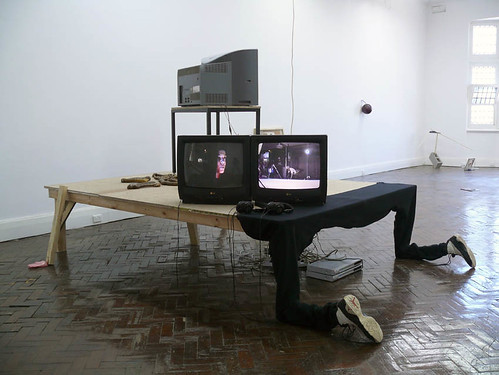
Ross Coulter’s Quartz for example, is made up of a basic wood frame supporting a TV, which displays an image of the artist’s head backlit by ethereal blue light. Underneath it a tiny monitor loops a few seconds of an animated human heart, set against a plain white background. At the bottom of the structure is another TV displaying a pair of feet, which dangle in mid-air as if levitating. Accompanying all this is a regular machine beeping noise. Although it looks like a half-serious, half-silly take on the phenomenon of the millennial religious cult, it could also be a high-tech, quasi-sacrosanct self-memorial. Closer to home it vaguely recalls the anonymous final message — “RIP Jodie & Steph” — posted by Melbourne teenagers on their myspace page just before they committed suicide.

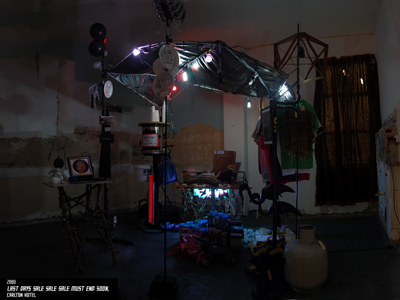
Simon Pericich’s LAST DAYS SALE SALE SALE MUST END SOON similarly plays with this self-memorialising, this time with a real garage sale of his and several special invited guests’ artworks and personal junk — t-shirts, cans of beer, a side table that looks like it’s made of sticks, a pair of boots, a gas bottle, etc., etc. The small crumbling room and weak lighting, as with Coulter’s work, can’t help but add to the pathos. So instead of your immortal soul leaving earth for cyberspace, the bleaker picture here is that what’s left over after the “last days” is simply a collection of meaningless stuff. In other words, Pericich’s emphasis is less on the spiritual and more on the material: on what you’ve left behind, living-on after you, as dead weight.
Michael Ascroft

3/17/08

Mark Wallinger with Bénédicte Ramade

Bénédicte Ramade interviews Mark Wallinger
Wallinger-inter
From 2001 until 2006, Brian Haw patiently constructed a protest camp next to the House of Parlement in London. The 40 meter spontaneous architecture of pictures, banners, posters, moaning teddy bears and many daily supplies were removed by 78 policemen and trashed in May 2006. A new law was introduced forbidding any demonstration within a zone of one kilometer around the House of Parlement, due to potential terrorist threat. Haw's pacifist camp, settled in this zone, was erased in one night. Fascinated for months by the involvement of Brian Haw and the commitment of the people, Mark Wallinger started to take some hundred or so pictures over the months before the destruction. After Wallinger decided to precisely recreate Haw's installation at the Tate Britain, then exhibited for 8 months, within the security perimeter. This demonstration booth against the war in Irak is now on view in France near Paris, at MACVAL.
read the interview

3/5/08

Six kinds of smoke

Greenwashing. Environment: Perils, Promises and Perplexities
Foundation Sandretto Re Rebaudango, Turin Feb-May
Cyprien g
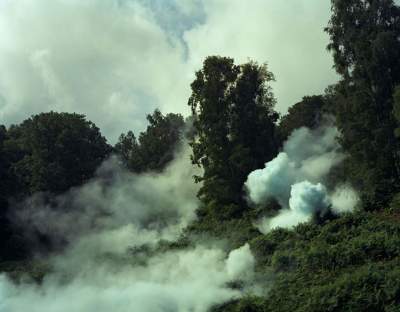
On Thursday night (28 Feb) Greenwashing. Environment: Perils, Promises and Perplexities opened in foggy, smoggy Turin. The European Union has recently warned that the city is consistently overstepping its smog and pollution limits in terms of days per year. Yet people are beginning to flock to this beautiful baroque city that was, until the winter Olympic Games, almost without tourists. I guess most of the art people arrived by plane. At the after-party in the city centre a bulbous cloud seeped and leaked up from a grill in the street and completely covered the people smoking outside the bar. Half fled and left the scene the rest sat there obliviously chatting in the late night. The explosion was in fact a spontaneous work by French artist Cyprien Gaillard using an industrial fire extinguisher. The impromptu gesture directly echoes his works in the exhibition which deal with “vandalized... graffiti-like,‘en plein air’ pollution clouds [that] redraw the landscape” and cite the conflict and disharmony in which the world began and thrives. In one clean moment maybe half the audience recognised it was a work.
Geoff Lowe
six-smoke

2/18/08

Katherine Huang

Neon Parc
1/53 Bourke Street Melbourne, February
Neon-Parc-001
Plastic
It's 2008 and nice to have a show that feels like the future. Katherine Huang's current exhibition at Neon Parc seems to hail from there, but a good one where plastic hasn't taken us down, but has become a new passable and appealing media. That's a nice thing artists can do, take something that’s tagged ‘bad’ and give it a good new go.
Studio
Huang's studio drawings feel familiar and set the exhibition like it's still being made or is about something that feels like making. I have had about enough of ‘The Studio’— as mysterious location where real things happen — on invites or in Art Collector interviews. I think Huang does it better and a bit further.
Placement
With titles like, ‘This Piece Is About Air. There's Nothing There’ (2008), Huang’s op shop buys, containers and placements cap the inbetweens and spaces. Huang seems to really want us to notice where she put it and where the object is found — that she definitely chose it and not the other way around. It seems like the tweaking could go on forever, including her audience in putting and preparing to arrive, rather than the studio invite opposite of that.
Kate Smith

2/17/08

Fuck Your Heros

West Space
Level 1, 15 - 19 Anthony Street Melbourne, February
Michael Ciavarella, Ross Coulter, Deven Marriner, Laith McGregor
West-Space
Michael Ciavarella’s “Kissing Cousins” pushed the connections between the tradition of the male artist-genius through macho celebrity worship via camp appropriation, to a strange commentary on the erotic charge than runs through them all. Basically, Coulter took a copy of Courbet’s Origin of the World and overlayed Ben Cousins’s “Such is Life” tattoo. In all, four different heroes come together: the artist-genius; the AFL star; Tupac’s “Thug Life” tattoo, from which the font and style of Cousin’s tattoo is appropriated; Ned Kelly’s famous last words. The associations between the hardboiled men play off one another in such a way as to affect a weird solidarity between them, in opposition to the background image of the woman’s naked crotch. But as a whole this exhibition’s generic, quasi-critical approach seems to undercut this more unexpected and interesting content.

More than that, the “one part homage to every two parts irreverence” approach to the hero isn’t really even quasi-critical because a constructed, ironic, and I’d go so far as to say a camp self-understanding is already an everyday aspect of masculinity today. That excessive macho-ness that Ciavarella’s “Kissing Cousins” focuses in on now runs through so much ordinary pop culture product that we already know that the excessively masculine man tends to be shown to be as unmanly as the traditional effeminate one. Which shows how camp as critique is well and truly absorbed into mainstream gender politics.
Michael Ascroft

*******************
I’ve only seen photos of the show Fuck Your Heroes, but making new work can’t escape the context of what’s been made/done before, and this idea is interesting for all the many relationships that it manifests between contemporary and predecessor. People often have feelings of aggression towards artists whose work is valuable to them, an anger at an idea having been ‘taken’, as though there are a finite number of ideas that are unlocked at points of time and consumed, used up. When Ai Weiwei brought 1001 Chinese people to Kassel for Documenta, my friend Hao Guo had a crisis, feeling that this was the most important artwork in the world so everything from then on that he made would be superfluous, or trivial, or diminished. But then later he found out that another Chinese artist, Yue Luping (see below from the interview), had done a similar project on a much smaller scale. Then, a question of power comes into play: Ai was financed by Swiss banks to realise Fairytale, so the scale was made possible by corporate wealth, but it’s hard to imagine a fairytale involving Swiss bank giants. Maybe this is the fairytale of contemporary art.

Speaking of power, when I first read a précis of Jean Baudrillard’s Forget Foucault (before I read FF) I was obsessed with what was claimed the essay was trying to do: that it was an imperative action undertaken by Baudrillard, necessary for him to become an independent thinker, as he felt too committed to Foucault’s ideas. So, fuck your hero to become yourself. I’m unsure if this was Baudrillard’s motivation, but since then I’ve paid more attention to the different ways that this tension plays out.

On the topic of dealing with inherited ideas of masculinity, I don’t think I can offer much… Not just because I’m not a man, but from my experience Man is (almost) a gender-neutral existence, while Female is steeped in gender. So almost all of constructed culture and history feels like it has largely been a study of what it means to be a man, coming after other men.
Liv Barrett
Yue Luping: Now in this festival, my work is “Journey To The West” of three platforms. One is “ Touring in the Western World”. Like present, China is copying everything from Western culture. I say it’s unfinished copy. Like you have toured around the city and seen all the Western signs like Mac and KFC. And our political structure also originated from Marxism and the economic system is……
Lennie Iee: copying capitalism.
Yue Luping: Everything is copying Western culture including AIDS. Now China has a lot of AIDS cases not really through sex intercourse. So I would like to comment on this unfinished copy, I think it’s a problem of modernization. http://www.ionly.com.cn/nbo/ionlyshow/ionlyshow1/yueluping/20051031/131650.html

2/4/08

A dinner with... Erick Beltran

KADIST ART FOUNDATION
9 bis - 21 rue des Trois Frères Paris, Sunday Feb 3 at 8.30pm Un projet de Thomas Boutoux, Natasa Petresin et François Piron, avec Benjamin Thorel et Oscar Tuazon
mussels
During the exhibition Société Anonyme, last March at le Plateau, Mexican artist Erick Beltran developed a body of work around the notion of synesthaesia as a metaphor for the translation of practices and the creation of links between unrelated things as a way of organising the chaos of signs. He worked full-time over four months in the art space organising workshops with children or art students, participating in debates, inviting scientists to respond to his experiences… This working method, based on exhaustion and energy expenditure, lead him to performances and presentations considered as never-ending events.

Last night Erick prepared a dinner at the Kadist foundation to accompany his discourse, considering different dishes as tasteful translations and creating the baseline for a conversation about synesthaesia between him and the 25 dinner guests. SPEECH asked a number of the dinner guest to respond, read on...

1/27/08

...excepté peut-être une constellation

220 jours
11 rue Louise Weiss 75013 Paris, une exposition en deux parties, janvier - février
220jours
This is an ongoing show about how the space or place is moving around. A one-eyed-view that consequently has no depth is pictured twice. There is a nomadic, ambulant video that was previously shown at La promesse de l’écran. You can’t cross out or deface this space here anymore, you are only able to make it absent or pristine. There is an impression of the globe on the floor. If this writing sounds hidden or arcane, so is this exhibition that will last 220 days. It is kind of mapping of what we don’t-know (together), but by showing how the place or space moves it prompts us to see that we already-know, what we sense we don’t (know). It’s like there is very little understanding but perception is fast. see http://www.220jours.blogspot.com
Geoff Lowe
image Aurélien Froment Pour en Finir Avec la Profondeur de Champ 2008

1/26/08

Christian Marclay

ACMI
Federation Square, Melbourne, Nov 2007 – Feb 2008
curated by Emma Lavigne, Cité de la Musique Paris
img_marclay_guitar_drag
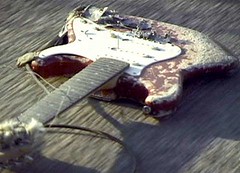
Cultural games follow rules that always allow for moments of freedom. Canny game-players sometimes use their artistic licence to reconfigure the rules. ACMI’s Replay: Marclay, a monographic exhibition of ten video works and some additional screenings and sound recordings by US/Swiss-raised Christian Marclay, shows us an artist using the rules of one game to play another.

He appears to follow the art game’s rules exceptionally. Whether Marclay’s objects are records, fluxus relics, or excerpts from old films become banal through repetition and the passing of years, in work after work we see the now sterilised remainders of deadened culture being reinvigorated in some way – percussed, sampled, mixed, refigured, disfigured, rhythmicised, made contrapuntal. Since Marclay tends to treat his raw material rather generically (the filmic contexts of his samples and the individual sound recordings he employs seem largely irrelevant to the work), this cultural reincarnation occurs most successfully in his work at a conceptual level, as idea or strategy. And as it happens, revitalising the moribund is one of the key strategies of the contemporary art game as it’s been played for the last few decades.

But when Marclay attempts to realise this strategy, he enters another game with other rules. It’s possible that the rhythmic stodginess of Crossfire (2007) as a percussion work (for sampled cinema gun-shooting) was partly due to poor playback synchronisation (elsewhere, only two of Gestures’ [1999] four audio channels were playing). With Video Quartet (2002), however, Marclay’s limitations within his chosen genre, the string quartet, were obvious. Stringing sonic and visual gestures together simply according to likeness and repeating samples across different screens in place of standard musical development, Marclay eventually effects a climactic amassing of sound and visual signs of tension (the strongest being the tearing of the curtain from Psycho) that is directionless and achieves nothing. Reigniting and remobilising the riches of reified culture has been an explicit objective of many composers – Berg, Cage, Mahler, Berio, Zorn, Rihm, Kagel, even the late Beethoven. Ignoring their moves, Marclay merely remoulds his remnants of the past into already redundant forms.
Huw Hallam
image Guitar Drag 2000, video projection 14 minutes

interview with Mierle Laderman Ukeles

During 2007 Paris based critic Bénédicte Ramade interviewed Mierle Laderman Ukeles. Ukeles has been artist in residence at the New York City Sanitation Department since 1977, devoting her entire career to thinking about garbage, recycling and ecology and the endless, invisible labor of keeping everything clean.
Ukeles

Mierle Laderman Ukeles: I had a huge long education in art, in international relations, the very best cause that you can find. But nobody, NOBODY, ever taught any culture of maintenance because it was not in the culture, it was excluded from the culture. You do all these repetitive works, not for yourself but works for the others. It has to do with not pursuing your own freedom but when you’re a maintenance worker, it doesn’t matter about your freedom, it matters about the person, or the city, or the building, or the anything, the institution, or even the planet itself.
click here to read the interview
imageHartford Wash: Washing, Tracks, Maintenance: Inside and Hartford Wash: Washing, Tracks, Maintenance: Outside, image and some introductory words lifted from a Women's Media Centre publication by Regina Cornwell

1/7/08

Hüseyin Bahri Alptekin

Huseyin

11/30/07

Rigorous Mundanity, or “Artists of the World, Connect!”

A Conversation between Justin Clemens and Anthony Gardner, 25/9/07

In June 2007 A Constructed World, as part of their exhibition Increase Your Uncertainty at ACCA, hosted a series of Conversations. Around 35 guests and audiences talked about Collectivity, The Changing Audience for Contemporary Art, Losers and Failure and Publishing Without Publishers. The last conversation focused on Art and Politics in Australia and included Anthony Gardner, Michelle Ussher, Jeff Khan, Justin Clemens, Mark Feary, Lisa Radford and Geoff Lowe.

This conversation didn't get to the point, only because their isn't one, focusing more on how "...it's compulsively difficult to talk about anything". "We seem to really lack a skill of repertoire and roles and discussion, racked with fear and guilt before speaking." Perhaps what was really being talked about is are we allowed to talk.
SPEECH invited Anthony Gardner and Justin Clemens to continue this conversation.

11/19/07

La promesse de l’écran

Pierre-Leg
Un milieu s'autorégule, il expluse, il absorbe, il se concentre, il se dilate et se reformate. Nul n'en connait les lois ni n'est à même d'en expliciter les habitus. Du moins s'il n'en sort. Emettons l'hypothèse que Pierre Leguillon travaille cette matière même, dans le cas très précis du milieu de l'art. Le vernissage comme situation expérimentale. Le milieu comme médium en somme. On évitera pour l'instant de se poser la question de son me/assage. PL en connaît suffisamment les rouages pour le faire se concentrer (à l'instar d'une société secrète comme ce fut le cas pour Les Promesses de l'écran qui se sont tenues le 15 novembre), mais laisse suffisamment indéterminé son propre statut (artiste ? curateur ? critique ? éditeur ?) pour se laisser une marge de manoeuvre qui lui permette de mieux travailler cette socialité si particulière du "tu fais quoi en ce moment ?" Nul doute non plus que l'alcool (qui coula à flot mais pour une somme modique ce soir là) soit un levier pour cette démarche. Nul doute non plus, comme Pierre Leguillon se plaît à citer Philippe Thomas reconnaissant que son travail ne foutait pas le bordel que dans les catégories mais aussi dans sa vie, qu'il n'en soit pas épargné de retour. Alors on se demandera quel bon dos ont les oeuvres projetées ce soir là, diaporées précédemment et accrochées dans d'autres (hélas trop rares encore) cas. Sont-elles des starters ? (mais alors de quoi ?) Des open-minders ? (mais alors pour quoi ?) Des prétextes ? (mais alors à quoi ?)
Vincent Romagny
image La promesse de l’écran 2007-2008 techniques mixtes, dimensions variables, photo credit Aurélien Mole

11/9/07

Are You Being Flocked?

The Carlton Club Hotel and Studios
193 Bourke St Melbourne, October
PAINTING-neon
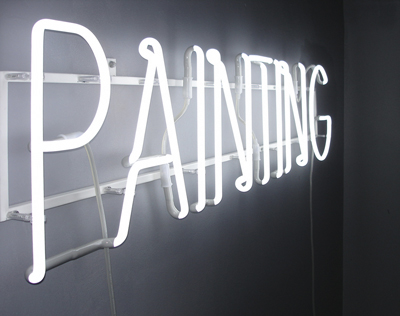
The campy title of the exhibition suggests a neat cross between fancy wallpaper and group mentality. But who is part of the flock? Stephen Bram, Tony Clark, Marco Fusinato, Melinda Harper, Fiona McDonald, Anne Marie May, Callum Morton, John Nixon, Rose Nolan, Kerrie Poliness, Kathy Temin, Gary Wilson plus Constanze Zikos, who curated the show and DJ’s on Saturday nights in the bar downstairs. Okay, so the list reads like a year on Flinders lane 5 years ago - and everyone got a look in - hardedge, faux-naif, fluffy, knitted, painted, abstract and architectural. So why don’t we do it in the road? Most of the artists in the exhibition are usually treated to pristine white gallery spaces and heavy institutional hangs – the sort of pedigree you wouldn’t expect to grace the walls of the one-bedroom-and-sink-sized rooms above the bar. But we’re all friends, aren’t we? Stay in groups uh.
Geoff Newton
image Fiona McDonald

11/7/07

NetAlert: Be afraid, be very afraid

NetAlert-002
In the recent three-part South Park episode ‘Imaginationland’ terrorists hijack our imagination seeking to eliminate the ‘good parts’, leaving only the ugly, evil and malicious creations of the human mind. This story provides an interesting reference point when considering the increased security measures today, such as the introduction of NetAlert in Australia, which is ‘part of the Australian Government’s ongoing commitment to providing a safe online environment for all families, especially children.’ NetAlert is a project that provides free internet content filter for download and general advice about protecting yourself and your children online. It comes as a response to increased fears of children being exposed to potentially disturbing and harmful material online, fuelled by almost daily reports of child sex offences, lurking paedophiles and easily accessible graphic pornography.
continue reading Uros Cvoro's text

11/4/07

Matthew Griffin

We Get Tricks
Uplands Gallery, Studio 2&3 249 - 251 Chapel Street Prahran, Oct 2007
Griff_video_install
There are tricks all over this show, Magic Happens (bowling ball and sticker) being the clearest example. But the best trick is the one that made me feel like a flake (being a maker it’s inevitable) – the artist/the trickster and the audience/the tricked. Griffin does this by dressing up and acting it out.

At the front of the show, someone big on all fours modelled a sunshine made of shit and a video piece. The sun’s design was redolent of a kind of coastal scene. Griffin seems to think this is bad, well, shit. Or what this stands for is. Things like Nature and dream catchers with feathers, a sloppy rhetorical kind of activism, wearable and sold at markets. Griffin’s intention to tattoo a hippy on a dolphin has been well documented.

The sun piece set up another video in which Griffin appears as a kind of gathering eco-artist tinker. This shifts Griffin’s target from the general to art. The footage takes place in the bush and then the studio. Here Griffin mocks a current version of art’s default relationship to nature. Griffin as young creative has his naturalness exaggerated by his upsized comedy manhood, made out of some foul kinked bit of balloon and a wig – seemed a bit itchy. He chooses twigs in a dumb reverential way, holding them up to the camera/audience for examination or proof. Later he returns to the studio to interpret his experience in a crappy organic wooden sculpture that doesn’t work and just falls about.

I can’t help but spell this all out because I really like this work and set of things. Griffin’s silly/floppy taps of the hammer are the cherry. Watching I start to feel like a hypocrite and want to give up and be a nurse or something. But it’s ok I’ll take it because I have not found many things that house my annoyance and give me back humour like this, and that’s what I want.
Kate Smith
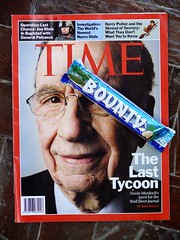
Griff_Bounty_Murdoch

Scott Miles

The Narrows, 2/141 Flinders Lane Melbourne, Oct-Nov 2007
wehavejoinedthe21stcentury_web-1
Somehow the accompanying text to this show really enhances the work in a way exhibition texts often don’t. The Narrows gallery provides a poster with an essay or creative text for each show. Not a new invention for a gallery, but they do it well.

To accompany his exhibition Paintings, artist Scott Miles has provided an extract from a fictional letter dated 1894. Signed Michel Marker, the invented nom de plume reads like a combo of Michel Foucault and artist/filmmaker Chris Marker – both have been proponents of the ideas at play in Miles’ paintings. Historical and futuristic architectural languages are mixed in works like ‘We have reached the 21st Century’, while an imagined heterotopic “other place” or parallel universe is presented in a painting of Flinders Street Station surrounded not by city traffic but grassy knolls. Many of the oil on board works are like travel shots, but unsettled, the truth of a place or time disrupted by memory or invention.
Rosemary Forde

9/29/07

Philip Brophy

Vox
Gertrude Contemporary Art Spaces, 200 Gertrude Street Fitzroy, Melbourne Sep-Oct 2007
brophy2
In a recent conversation with Melbourne artist Lou Hubbard, she pointed out that the nexus of Brophy’s work is his fascination with communication. Communication, or more to the point engendered or sexualised communication – how we do it, why we do it and the slippages that occur between what’s on the surface and what’s really being said.

Using logo and branding, Brophy pushed VOX like a consumable product. Treating the GCAS shop-front like advertising space, he generated considerable excitement about his new work. Vox interacted successfully with the window in a way that I hadn’t seen since Spiros Panigirakis’ – albeit very different project – Without, in January 2006.

After recovering from the disappointment of not actually seeing the video component of Philip Brophy’s work at the opening (don’t be under the popular misconception that people don’t view artworks at openings) I went back during the last week of the exhibition for another look.

I can forgive VOX its technical flaws because it’s more the content of Brophy’s work and his particular vision of the world that I find so interesting. The GCAS media release presents VOX as a ‘sexualised visualisation’ of the romantic comedy, but it’s not simply a subversion or interpretation of a chick/dick flick, it’s also a sad anthropological study of what we humans do and say to one another on a daily basis; love me, fuck me, want me, understand me. This combination of insights into gender, sexuality and semiotics combined with his glam rock, Ziggy Stardust aesthetic is what draws me in. But a level of presentation that’s as sophisticated as the work is insightful will keep me coming back.
Meredith Turnbull

9/28/07

brophy
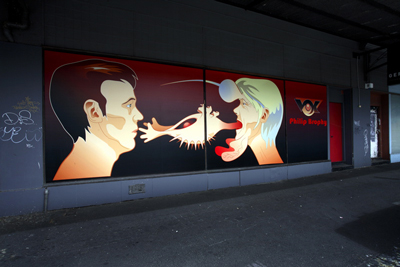
Two heads, male and female, stare blankly at each other. Then the lips of one extend, contort and grow outwards, as a large pseudo-sexual organ sprouts from its mouth. This growth enlarges and transforms, reaching across the screen as more transformations take place. The head gags and convulses, other bits that look like flippers, teats or testicles grow out of the forehead and cheeks, sprouting fine tendrils and glowing antennae. When they reach the other face they brush up against it and retract. The main female growth is part vagina, part puffer fish, part obscure seaweed, while the male equivalent is more penis-y, sea cucumber-like.

The mutations are synced to a revving electronic sound that is mapped across five speakers, following the bits across the screens, twisting and time-stretching in unison with their contortions. When one completes its display, the other begins and so on.

Brophy's themes are all here; sex dragged down from the hetero pedestal and reformed according to the rules of science-fiction, anime, horror films and pornography, divorcing then reattaching itself to cartoon and alien bodies. It's as if he takes John Gray's word to the letter – when it comes to sexuality, men really are from Mars and women really are from Venus. Or in this case, the aquatic theme would suggest these mutants crawled out of the sea on Neptune. For them, flirting takes the form of spewing genitalia.

And it sounds great on paper, especially in the catalogue essay, but in light of a series of inconsistencies all the grotesquerie seems half-finished, or at least rushed. While one head writhes about the other is weirdly still, like an icon on a website that you would expect to flash or sparkle when a cursor moves over it. Elsewhere tentacles lose their animated connection to the face they've sprung from, or the main organ-thingy appears to move on a different layer to the mouth, and so the illusion vanishes.
We can't let him get off so easily.
Michael Ascroft

One Word Responses to the Biennale de Lyon

Biennale
OUTSOURCING
François Piron

Hamilton_001
art-nègre
Sylvie Boulanger
David Hamilton invité par Eric Troncy
image: détail de l'installation, 34 photographies, avec le soutien du British Council, avec le soutien de Sikkens-Vachon, crédit photo Blaise Adilon


Wade_Guy
WATCHING-(YOU)
Judicaël Lavrador
Wade Guyton invité par Scott Rothkopf

Dis-connection
Cecilia Canziani

Cao-Fei
Moot(noun)
Matthew Shannon
Cao Fei invité par Hu Fang
image: Shannon


Lyon-001
post-post-post-post[…]post-post-post-post-modern
Etienne Bernard
Brian Jungen invité par Trevor Smith
image: suc1 0084: vue d'installation, sacs de golf, tube en carton, collection privée Toronto. Courtesy Catriona Jeffries gallery, Vancouver,crédits photo Blaise Adilon.


No-play-on-display
Charlotte Laubard

Lui-Wei
Sausages
Daniel Dewar
Liu Wei invité par Pi Li
image: « Seesaw », 2007, résine plastique et bois, métal, 500 x 150 x 1600 cm. Courtesy Liu Wei et Universal Studios, Beijing, crédits photo Blaise Adilon


R.I.P
R.I.P.
Thomas Boutoux

explosition-001
Marie Muracciole

nomeda-gedimas
unannoying
Geoff Lowe
Nomeda et Gedimines Urbones invité par Natasa Petresin
image courtesy of the artists


Deception
Antoine Marchand
Tino Sehgal invité par Jens Hoffmann

eco_01
ECOSYSTEME
Bénédicte Ramade
Tomas Saraceno invité par Daniel Birnbaum
Flying garden/airport city/60SW 2007, 60 ballons, cordes, 280 cm de diamètre,
courtesy de l'artiste et Tanya Bonakdar gallery, New York, Andersen-s contemporary, Copenhague, Pinksummer contemporary art, Gène, crédits photo Blaise Adilon


Cinthia
Glitch
Mathilde Villeneuve
Cinthia Marcelle invité par Jochen Volz
screen capture,Fonte 193 (Fountain 193), 2007, vidéo 5'40" en boucle, courtesy de l'artiste et Gallery Box 4,crédits photo Blaise Adilon

9/23/07

Roni Horn

A Kind of You: 6 Portraits
Australian Centre for Contemporary Art, 111 Sturt Street Southbank, Melbourne, Aug-Sept
Horn-Isabelle

Flowing emotions, borderline crazy.
Elin Haukeboe

The blurred in-motion faces of the clown creates a flashback to Stephen King’s film ‘IT’. Not what I would expect as an introduction to the exhibition. Or any other art exhibition.
Joel Hui Tan

The subject is obscured on several levels, introducing the concept of masking the mask - as if to avoid recognition, though assuming an already impenetrable guise.
Jordan Russ

You walk in to a space, all eyes upon you, you feel as if you’re being questioned, yet you’re not self-conscious.
Miki Petrovic

Face, raw and fleshy.
Ben Callinan
click here to read more one-sentence responses to the exhibition from photography students at Deakin University
image: Roni Horn, Portrait of an Image (with Isabelle Huppert) 2005, courtesy ACCA

9/7/07

Regarding Fear and Hope

Monash University Museum of Art and Faculty Gallery
Melbourne, July – August
Curated by Victoria Lynn
MUMA_00_20
Spread across both Monash campuses, Regarding Fear and Hope reads like a mini-biennale – not surprising as it was developed at the same time as curator Victoria Lynn was working on Turbulence, the 3rd Auckland Triennial. The two projects included many of the same artists and used a similar curatorial rhetoric.

If you believe curators we must always be living in turbulent times. Perhaps curators are a particularly anxious or sensitive bunch, I guess travelling and hanging around artists all the time will take a psychological toll. Or perhaps it feeds from the ever-present notion of crisis in contemporary art. Or the expectation of these major biennale type shows to make some kind of internationally relevant zeitgeist statement – isn’t that what coca-cola does?

Avoiding these issues of biennale hype, the more focused and localised scale and scope of Lynn’s Monash exhibition allowed for a more direct and intimate experience of the artworks and the issues raised. The DVD triptych maang (message stick) by indigenous Australian artist r e a builds upon archival material layered with images of the Australian landscape and words in the Gamilaraay language. The multiple readings of history and myth overlap in this work dealing with the turbulence of colonisation. Collaborative works by Janet Burchill and Jennifer McCamley referenced the 1973 Fassbinder film (the story of an inter-racial and inter-generational love affair) in the neon piece Fear Eats the Soul.
Rosemary Forde
MUMA_00_6
Regarding fear and hope, installation views, Monash University Museum of Art 2007, photography Christian Capurro

Experimenta Playground - Biennial of Media Art

Experimenta Playground - Biennial of Media Art
The Arts Centre BlackBox, Melbourne Aug-Sept
Help-your-self
Once my Mum emailed me a link to some virtual bubble wrap. I really enjoyed popping the bubbles with the mouse… for about two minutes. A lot of new-media art has the same limited pull for me. I visited Experimenta Playground to test my prejudices. Just inside the entrance is an interesting looking video featuring the artist Kuang-Yu Tsui, changing his clothes in urban spaces. I watch a while but keep getting bumped by gormless tourists entering. A stupid placement so I move on. Inside the space it’s hard to adjust. Screens and sounds blink franticly like a gaming arcade. Gangs of kids jump at anything that glows while their parents mull about like cows.

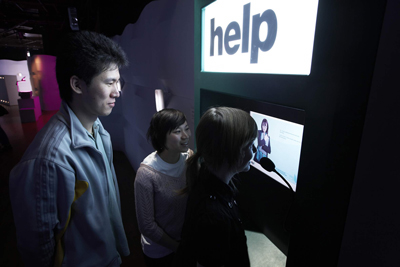
Narinda Reeder’s work is an ATM style kiosk providing lifestyle advice to the disillusioned. Help Us Help You Help Centre. I wait behind a couple of boys trying to get the computer-generated voice to register their name as “Dildo Fuckface”. The kiosk seems to be getting pissed off and eventually freezes in protest. I don’t get a turn. A stylish couple are swooning over the “cute little monitors” in a work entitled ‘Charmed’. I’m not charmed. I feel like I’m in a soulless Sony showroom. The artwork seems almost secondary to the technologies featured. Some works would make great screen savers. The virtual, interactive fishpond entitled ‘Immersion’ reminds me of a high tech version of the ‘burning log’ video once sold on infomercials.

Shaun Gladwell’s simple slow-mo video of himself skating around various public fountains is like catching a breath. I catch snatches of a moody soundtrack but it’s drowned out by the blinking jangle. I imagine Shaun’s work would be great amplified and projected but it’s lost in these surrounds. I give up and head off to Ikea for another dose of masochistic people hate. I need new picture frames.
Jolly Johnson

9/5/07

Abstraction/Architecture/Space

RMIT Project Space Spare Room, Melbourne Aug–Sept
Justin Andrews (Curator), Stephen Bram, Bianca Hester, Kyle Jenkins, George Johnson, John Nixon, Kerrie Polliness, Sandra Selig, Masato Takasaka, Inverted Topology (Danny Lacy, Gemma Smith and Mimi Tong)
project-space
Justin Andrews has curated a highly considered and elegant exhibition for RMIT Project Space and Spare Room. Titled Abstraction/ Architecture/Space, he has eloquently selected twelve artists of diverse experience and development whose practices deal with the convergence of these themes. Andrews follows a somewhat traditional curatorial model but maintains a natural flow and easy relationship between works. But it’s Carolyn Barnes’ accompanying catalogue text that generates a critical perspective on the history of these artists’ practices and fully investigates the curatorial premise.

Three works in this exhibition provide the most exciting points of conflation between ideas in and around abstraction, architecture and space. George Johnson’s Sonata No.1, 6.2.2005 uses acrylic on canvas to convey dynamism of form and colour in an arrhythmic abstraction. Sandra Selig’s volumetric sci-fi installation Time isn’t holding us explodes a geometric web of white elastic from rock and Stephen Bram’s Untitled (Two Point Perspective) pigment print on paper obsessively overlays black lines to provide an intensely warped moment of amplified architectural drawing.

Discussing each artist in detail, Barnes cites various influences and antecedents to these works from Bauhaus to Minimalism-Conceptualism and examines the traditions and contemporary relevance of Modernism within an international and Australian art context. Abstraction/Architecture/Space is an exciting exploration of new developments in non-objective art and contemporary modes of abstraction.
Meredith Turnbull

*****
RMIT’s glass-fronted Project Space is more retail showroom than abstracted white cube. A sense of overwhelming transparency dominates, one is caught in the glare of the high beam – nowhere to run, nowhere to hide. It’s the type of paralysis we see in retail display.

The current exhibition Abstraction, Architecture, Space, curated by Justin Andrews, creates a light, yet self-assured footprint in this display cabinet. Drawing on the over-exposed conditions as a metaphoric and material opportunity, the show flows easily between specific responses to the gallery environs and a more generalised hermeticism, typical of historical abstraction.

For example, Stephen Bram’s work Untitled (Two Point Perspective) is wryly hung directly opposite the front glass wall. Rather than a face-off between the contained art object and the random, moving images of the street, this small, framed work acts as a projector of the prevailing conditions, without getting specific about it. Bram’s outreaching refractions break through the frame, creating a sense of continuum with the present, encapsulating the responsive sense the show has as a whole.

Rather than a testament to the survival-machine status of Modernist abstraction, the works, and the way they come together, are as resolutely about now as any more fashionable takes on relativism. The familiar sense of high-mindedness typical to the idiom is not apologetically undermined, rather, the continuing dilemma of being in the world – of conjecture, potentiality and process – reigns over any sense of aloofness or estrangement. Revisionism is not on the agenda.
Adrien Allen

*****
(see details for this exhibition on the post below)
It's great when artists can pull off a curated show with a fancy essay, nice catalogue and impressive mix of works. As an artist you can maintain the autonomy of a practice and closeness to your peers, while I guess as a curator type you're always torn between choosing specific works to feed the 'vision' of the show and teasing out new works by artists to extend their practices and take a few risks. Both can be said of this show by Justin Andrews, who has succeeded in defining links between abstraction and architecture by inviting a handful of this country’s foremost spatial/abstract practitioners to live the dream. Each work has been carefully selected to occupy a specific space within the gallery and each space within the gallery has been occupied nicely. I forgot about the premise and just enjoyed seeing a bunch of great works working together.
Geoff Newton

8/17/07

Tao Wells

a performance by Me
Studio 18, Gertrude Contemporary Art Spaces Melbourne, 26 July 2007
Tao-Wells
The eighth in series of performance projects in Tao Wells’ practice, this latest version is based on a recreation of a conversation between the two performers about the performance. Wells’ performances obey rules set out previously and agreed on by the performers-to-be, things like ‘write only what you say and everything you say’ and ‘Remember that you are creating now what will exist later. This causes fear and excitement.’ The resulting text becomes the script for the performance, which is also put onto overhead sheets and displayed by a projectionist, who becomes another character or director by having the power, according to the rules, to decide when and where to stop the performance. The twist to this version is that the two performers are on intimate terms, so in re-enacting their conversation about the performance, the audience also gets a re-enactment of a little snippet of their private life.

It’s hard to know how to approach this work, whether it is more interesting to ‘observe’ – describe how the performers make us tease out an artificial line between the ironic performance/reality of sexual tension between them, which in any case turns predictably stale as it starts to drag on, as they repeat the same lines in slightly different but unexciting ways; or ‘critique’ – ask why Wells talks up the method of using a system that the performers have no choice but to work with, when they don’t bother following the rules very closely, or why he makes a thing out of it being impersonal if he is at the centre? The other approach is the ‘review’, which this hopefully serves as – visiting NZ artist, in collaboration with local, makes sometimes intriguing but mostly forgettable performance art, despite his other work looking and sounding much more interesting.
Michael Ascroft
photo: Niki Wynnychuk

3/12/07

Doomsday Celebration

castillo/corrales
65 Rue Rebeval 75019 Paris
15-17 February, by appointment until 23 March 2007
DoomsdayVito-Accon
We had heard the gallery didn’t send out invites, which were mainly by word-of-mouth. I understood almost nothing and didn’t recognise any of the works when I first saw the exhibition at castillo/corrales gallery. Then the gallerist brought the show to life with a friendly twenty minute narration about the artworks: in Jay Chung’s there was no film in the camera over the two years the movie was made (the actors got mad), in Vito Acconci’s a girl tried to kill herself after a three-way-love- experiment failed in 1970, in Maurice Girodias’ novel about Henry Kissinger, a girl who planted drugs on the author went suddenly missing before he was arrested and deported, and in Gardar Eide Einarsson’s poster after every absence there was a blank. Yesterday a well-known critic told us that she rarely actually sees an exhibition she writes about (ahead of time) for art magazines because of deadlines. Then the gallerist had told us that this was the last show of the gallery and they would now work towards the first because they would start by being exhausted and knowing, as in this one, and end with the first being fresh innocent and optimistic about the gallery’s future. So SPEECH decided to invite ten people (read the reviews) to write about Doomsday Celebration without having seen the exhibition that took place from February 15-17. This is part of a series of reviews about not-knowing as a shared space.
Geoff Lowe
read texts by Pelin Uran, Rosemary Forde, Nadia Fartas, Cecilia Canziani, Elizabeth Presa, Hao Guo, Judicael Lavrador
DoomsdayWhen-where
images:
Vito Acconci Score 1970
Jay Chung Nothing Is More Practical Than Idealism 2001

2nd International Biennial of Contemporary Art of Seville

The Unhomely, Phantom Scenes in Global Society
creative director Okwui Enwezor
26 October 2006 - 8 January 2007
TH-Re-BIACS-2-1
The second Seville Biennale marked Okwui Enwezor’s return to the “mega-exhibition” format for the first time since 2002’s Documenta_11. It also marked a shift in his critical focus: from the series of postcolonial displacements that underpinned Documenta_11, to a single-city exhibition grounded in a single theme. Enwezor reprised Sigmund Freud’s theory of ‘das unheimlich’ (literally translated here as ‘the unhomely’) and filtered it through contemporary geopolitics after the terrorist attacks on September 11, 2001, with particular reference to the ‘unhomely’ internment camp at Guantánamo Bay in Cuba and the ‘bare life’ of its generally rightless and unsighted inhabitants.
click here to continue reading Anthony Gardner's review

image, Thomas Hirshhorn installation 2006

2/6/07

Curating Degree Zero Archive: interview

CDZseoul_index
In collaboration with www.curating.it, SPEECH presents an interview with Barnaby Drabble and Dorothee Richter, curators of the Curating Degree Zero Archive. CDZA is a comprehensive archive launched to research, present and discuss changes in the practice of freelance curators, artist-curators, new-media curators and curatorial collaborations. The project focuses on an expanding archive about these practices, which is touring as an exhibition, accompanied by a programme of live events and discussions.
The www.curating.it team is Daniele Balit, Cecilia Canziani and Benedetta Di Loreto.
Read the interview.
image: Curating Degree Zero Archive, Insa Art Space, Arts Council Korea, 90 Wanseo-dong, Jongno-gu, Seoul, Korea. Display and re-interpretation by Sasa(44) & MeeNa Park
Curating Degree Zero Archive
www.curating.it

12/29/06

A refreshing week with Martha Rosler

Martha Rosler: Art & Social Life; The Case of Video Art
unitednationsplaza Berlin,10 December 6pm
Berlin-PU-01
[Rosler's] seminar foregrounded a crucial aspect of video, which is easily overlooked at the moment. This feeling was amplified by an exhibition ... The Art of Projection: Films, Videos and Installations. The videos included in the show, especially those dating from the 1990s onwards, revealed how works are becoming more and more monumental and sculptural in stark contrast to the low-tech, low-profile features of the early days. The Art of Projection, which was just one of many similar shows, made me realize once more how much video has lost its emancipatory aspect particularly in comparison to the videos I had seen over that one week. read the article
Pelin Uran
image: Hamburger Bahnhof Museum Fur Gegenwart, Berlin
also see unitednationsplaza

11/3/06

Old News

cneai = ile des impressionnistes chatou, Oct-Jan 2007
curated by Jacob Fabricius
karl-perf
In this exhibition Jacob Fabricius presents Old News no 1 and 2. Free newspapers compiled with reprinted articles from newspapers chosen by invitees worldwide over 2004-5 (with 2006 now being compiled). The exhibition is a series of reading rooms with news exhibits, archives and furniture constructed from stacks of Old News newspapers. On the opening night artist Karl Holmqvist made a performance, reading from Old News in different languages. SPEECH asked Karl Holmqvist about his newspaper readings...
See news about Old News at www.porksaladpress.org.

10/26/06

The Nerve Meter(re) 0.0011

David O’Donoghue
Conical Inc 3 Rochester Steet Fitzroy, October 2006
David-O'Donoghue
Described as part instrument and part installation, The Nerve Meter(re) 0.0011 worked as a perfect syncopation of the visual and audible. With its bubble-bright cables and boxes visually echoing Mondrian modernism, or Ikea design depending on your cultural references, the whole gallery became one nervy system. With all these unruly storage systems pretending to contain the intangible, moving into and through the space felt like being inside an iMac.

The usually unnoticed or ignored noises of the Conical gallery and its surroundings were recorded by the artist on an earlier visit. Recordings were then composed, amplified, distorted and reset daily in the space alongside the audible hum of shortwave transistor radios – all allowing an element of accident, or maybe the will of the work itself to have a presence. The physical aspects of the work trying in vain to store or compartmentalise stuff that is uncontainable.

Branded as a “Conical Curated” project, this has certainly been a highlight in the Conical program, but aren’t all shows at Conical selected and supported by the committee? It looks like a few Artist-Run Initiatives in Melbourne are starting to provide more support for certain exhibitions allowing for larger scale or interstate work. It’s great they are finding ways to develop extended projects and it will be interesting to see what kind of impact these shows may have on overall programming for ARIs.
Rosemary Forde

Table of Contents

Common Room 2
465 Grand Street New York, Sept - Nov 2006
Common-Room
I have an ongoing conversation with a friend about Australia being ahead of the rest of the world in a number of ways. Australia took the lead in a new wave of neo-conservatism when it elected and kept re-electing the Howard government. The USA followed suit, Italy got themselves Berlusconi and Britain moved the whole centre-left to the centre-right.

Given the conservative cultural condition that has ensued, the ‘alternative’ art scene, particularly in Melbourne, has never been without a good idea. One of these was Melbourne’s MIR 11, a space in the foyer of the offices of architects ARM, on the 11 floor of a public car park. Now closed possibly due to differences of opinion between the directors of MIR 11 and the architects, more specifically ARM removing artworks they didn’t like from MIR 11 exhibitions (read more here especially comments).

And as one artist-run space closes usually another one opens or more interestingly becomes nomadic such as Clubsproject. So it is with interest that we note the first exhibiton at Common Room 2 a space in the foyer of Common Room architectural offices in Manhattan's lower east side. A project that will be continually renovated in an open-ended process of participatory decision making. go to review
Jacqueline Riva

10/19/06

More Studio Visits Melbourne

Chiara&Roberta
'After having spent almost two months in Melbourne, we consider the truly distinctive element of the city, and a source of pride, its strong presence of artist-run spaces and artist-run initiatives.' read more
Italian curators Chiara Agnello and Roberta Tenconi were in Australia between July and September 2006
see earlier post about studio visits

10/18/06

Sydney Biennale 'Politics in Aspic'

2006 Sydney Biennale June-August
Adrian_Paci
'Politics in aspic', a close friend said of the 2006 Biennale of Sydney Zones of Contact, and try as I might I cannot disagree with him. click here to read Jarrod Rawlin's review of the 2006 Sydney Biennale
Adrian Paci
Noise of Light 2006
thanks to Flash Art for permission to publish the unedited version of this text first published in Flash Art October 2006

9/24/06

Jiri Kovanda Versus Rest Of The World

gb agency
20 rue Louise Weiss Paris, Sept – Oct 2006
curated by Guillaume Désanges and François Piron
expo-Jiri-Kovanda

I have been to gb agency a number of times. At the opening of a group show there I asked a friend/critic to explain the idea. He told me to wait and went to talk to the gallerist. After more than five minutes he returned and relayed the gallerist’s words with much detail. I see the gallerists there talking to everyone.

I was there recently to see this show and wanted the list of works. The gallerist asked if I knew the artist’s work and then spent a considerable amount of time explaining the works and the curatorial concept to me. I didn’t feel mistaken for a collector and I appreciated that the gallery takes seriously their role as ‘agency’, as action and medium between the artist’s work and the audience in a one-on-one interaction. Unusual in this time, such a positive gesture towards speech and contact.
Jacqueline Riva

9/2/06

Interview with Pelin Uran

Continuing the discussion about curator/artist studio visits SPEECH asks Istanbul based independent curator Pelin Uran a few questions.
pelin-photo-2
'During my first studio visits I did not have any idea of the dynamics or power relations taking place, therefore I was not picky at all. It was simply about getting to know the works of the artist.' click here to read the interview

7/29/06

The Readymade in the Age of Google Economics

Victoria Park Gallery
250 Johnston Street Abbotsford Melbourne, July 2006
featuring Be Young & Shut Up Council (Azlan McLennan & Michael Ascroft)
Vic-Park-01
I did not see all of the images in this exhibition. I did not sit down. I did not watch the looped footage stop and begin again and again. I did not stay long. I felt sick. I wanted to go outside. I asked myself – what is the point of presenting these images in an exhibition framed by the history of readymade art? read the review
Amelia Douglas

6/30/06

Studio Visits, Melbourne

Who makes them, who gets them?

Charlotte Laubard, Paris based freelance curator and critic, was in Melbourne over June as part of a residency auspiced by the VCA Gallery. Laubard has the reputation of being interested in artists and ever-ready for a studio visit. Over a three week period Laubard met with and visited the studios of Adrian Allan, Brook Andrew, Jon Campbell, Christian Capurro, Kate Consatine, DAMP, Julie Davies, Alicia Frankovich, Kate Fulton, Tony Garafalakis, Bianca Hester, Lou Hubbard, Michelle Ussher, Susan Jacobs, Kati Rule, Simon Maidment, Nick Mangan, Amanda Marburg, Alex Martinis, Rob McHaffie, Tom Nicholson, Kain Picken, Alex Rizkalla, Geoff Robinson, Kiron Robinson, Johnny Targan, Elizabeth Newman and Kati Rule, Amanda Marburg, Sharon Goodwin. Charlotte visited galleries including Uplands, Ocular Lab, ACCA, Victoria Park and Gertrude Contemporary Art Spaces - and the Sydney Biennale.

Jen Budney, curator at Kamloops Art Gallery Canada, on her way to the Sydney Biennale, stopped over in Melbourne for six days. Budney met and made studio visits Callum Morton, Elizabeth Newman, Johnny Targan, Christian Thompson, Tom Nicholson, Jon Campbell, James Lynch, DAMP and Brook Andrew. She also visited Uplands Gallery, Gertrude Contemporary Art Spaces, Victoria Park Gallery, MUMA, Gabrielle Pizzi Gallery and Anna Scwhartz Gallery.

Carolyn Christov-Bakargiev, the 2008 curator of the Sydney Biennale and chief curator at Castello di Rivoli Museum of Contemporary Art outside of Turin, also meet with artists and visited galleries in Melbourne. ACCA hosted a curatorial lab for Christov-Bakargiev, Zdenka Badovinac, director, Moderna Galerija Ljubljana, Slovenia
and Patrick D Flores, curator and writer, from the University of the Philippines, to meet Melbourne artists and see their work.

Flash Art studio visits

6/16/06

Zones of Contact

2006 Sydney Biennale June-August
Rebecca-Belmore
SPEECH talks with Rebecca Belmore about the Sydney Biennale:
'… It was almost like I was never there. It was the second time. I had been at Pier 2/3 in Sydney in 1998. It’s strange to go such a distance to almost exactly the same spot and never have any sense of Australia.

There was funding for us to go to Australia and New Zealand from Canada, to connect with Australian Aboriginals and Maoris, in the 1990’s but I didn’t go then.

The Biennale puts a lot of pressure on you to be clever in an intense and simple way. Trying to fit into someone else’s ideas of what they want you to say. It’s a game trying to figure out the curators desires and your own. Many voices, many places, about political issues, but it wasn’t clear what the message was. Was it that the world is a terrible place and we’re all fucked? When you are in this company of voices is it for people to come to the Biennale, as tourists, to see how horrible it is in all these places?'
Rebecca BelmoreUntitled I 2004 inkjet print on paper 150 x 104cm
courtesy of the artist, photo Donna H. Hagerman

James-Lynch
The Party's Over
see Lowe's comment

Cälin Dan

MCA Sydney
Calin-Dan
Cälin Dan's video work Emotional Architecture 2 - Sample City is one of the few works that I really got something out of in this Biennale. I want to feel changed when I go to these kinds of shows, to know something I didn't already know, or to think: I wish I thought of that. I like that feeling. That's what I'm here for. So in the Sample City work a man walks around with a door tied to his back, through the rocky outskirts of a town somewhere very far from Australia. The light and the landscape are unfamiliar. He seems childish in a way I can't explain. No one bothers him, he just walks, sits down and rests occasionally. Alex Rizkalla told me that the work relates to a story about a young man who leaves the family home and is told to pull the door behind him. Kind-of a sad story about a naive man who then carries the door around for God knows how long. He said that when Dan shot the work back in Romania people remembered the story from their childhoods and they understood what he was doing. They said hello to him, didn't bother him, helped him and let him on his way.
Jacqueline Riva
Cälin Dan Emotional Architecture 2 - Sample City 2003
production photo from video 11.40 mins, courtesy of the artist

6/12/06

Daniel Dewar & Grégory Gicquel

Read the weblog of French curator Charlotte Laubard and artists Daniel Dewar & Grégory Gicquel. It documents preparations for the artists' exhibition at VCA Gallery Melbourne opening 29 June as well as the curators studio visits with Melbourne artists.
art-work

6/11/06

Sharon Goodwin

Uplands Gallery
Level 1, 12 Waratah Place Melbourne, May/June 2006
Sharon_2006
When I lived in Japan there was a museum exhibition in Tokyo of mythic animals called Youkai. Like most cultures the Youkai in Japan serve the purpose of telling moral and ethical tales – they embody a way of living, courtesies, cultural niceties. In Japan these symbolic mythic monsters could take a real form – a taxidermed fish and small possum were sewn together – proof to children that these creatures did exist and should be heeded. Youkai, I guess then are like a form of control, an enforcement of a particular hegemony. But on the other hand perhaps they could be reminders, prompters or cue cards; a genius seculi of a certain time. The sleep of reason breeds monsters and Sharon Goodwin’s exhibition at Uplands, Tomorrow is another today, is perhaps, like Goya and the Youkai, a pertinent reminder of our own apathy. The cyclic nature of the title pessimistically eludes perhaps to our present political climate and our own stumblings through life. Change can sometimes move slowly. The nightmare of the small but engulfing installation, a metaphor of our internal conflicts or the rumblings in our bellies coming to the surface. Contrary to what we are lead to believe the personal and the political often intersect. Goodwin’s exhibition, in gothic beauty, succinct and poignant, rendered in graphic starkness of black and white, eeirely illuminated with a hellish red light, points us to an underground where many are one, and one is at war with everyone.
Lisa Radford

5/23/06

Janenne Eaton

Helen Maxwell Gallery at Silvershot
3rd Floor 167 Flinders Lane Melbourne, May 2006
skullncrossbones
Nothing banner (verso) skull & crossbones 2006 enamel on canvas 226x251cm
Punk followed the Elizabethan urge to bring threatening unwanted theatre to where those with power stay. Janenne Eaton's painting show shows us that some at-the-top feel some rage and disgust at where-we-are and what we-have-become. Direct and focussed it's like New York prowess. What we need is a new collector class of Cubs.
Geoff Lowe

5/4/06

Packet Agency

curated by Jesse Birch (Canada)
TCB Gallery
Level 2/12 Waratah Place Melbourne, May 2006
Packet-Agency
packets contained instructions and art works which were installed by the audience
秘方新编(改编自传统相声)

我最近水土不服,浑身痒痒,洋人医生说我花粉过敏,得花钱买药。我一穷中国学生天生和他们洋人DNA不同,而且洋药都有不同副作用,所以我决定向我的中国医生朋友要个秘方(决不是因为嫌贵),我朋友跟我说他祖上正好传下来一个秘方,专治痒痒,而且正好他要回国,所以可以等他一到国内就向他爹要来寄给我。我是万分感谢,当天请他在墨尔本最大的馆子吃了一顿。第二天开车把他送到机场惜惜而别。我哥们还真够朋友不到一个星期祖传秘方就从中国寄来了,看到大信封我万分激动,手心出汗,折磨我近一个月的过敏症就要治愈了!我打开信封,里面是一个大纸包,我打开纸包发现里面还有一个纸包,我继续打开里面的这个信封并希望这是最后一个。不出所料,祖传秘方就在里面,而且只有俩字“挠挠”!
Hao Guo

5/3/06

Not-knowing as a shared space #12

The other side of things Bus Gallery
Colleen Ahern Neon Parc Gallery
Rosebud Victorian Tapestry Workshop

Responses to three Melbourne exhibitions by artists and people not usually involved in contemporary art
DarriLorenzen
Darri Lorenzen

3/25/06

Blair Trethowan

On March 3rd Melbourne gallerist Blair Trethowan passed away. Blair was a director of Uplands Gallery, a skateboarder, an artist and a big personality around Melbourne. There are few words to express the loss that his passing leaves with his family, friends and colleagues. Blair was a great patron in his generation.
northfitz-2
click here to continue
Uplands Gallery will re-open on Saturday 1st of April with its new program for 2006. The gallery invites you to attend the opening and pay respect to Blair Trethowan. Business as Unusual is an Uplands Team Show. Opening: 2:00 - 5:00 pm. The exhibition will run until Thursday April 13.
Bus-Unusual
installation: ACW, Sharon Goodwin, Julia Gorman
UPLANDS_LOGO-2

3/16/06

+Plus Factors

curated by Juliana Engberg as part of the Melbourne Festival
in locations around the streets, laneways and cafes of Melbourne
March 2006

Inverted-Topol
installation view ACCA Inverted Topology Justin Andrews Anna Finlayson Danny Lacy Kyle Jenkins Quentin Sprague Masato Takasaka Mimi Tong

Something was seeping stealthily from a fissure in the northern cliff-face of ACCA this March. The building appeared to have burst its seams, vomiting forth abstract geometric entrails. Or was it a rare angular orchid taken root in a crack in a ruin's edifice? Or were we looking at a sucker on the side of the mothership, once symbiotic, now a mutating, proliferating, parasitic outgrowth?
Presenting a model of teamwork unconcerned with medals, time trials or finishing lines, Inverted Topology was invited to participate in +Plus Factor, ACCA's response to the Commonwealth Games. Scraps raided from ACCA's store–room were stacked, leaned, balanced and propped against its rusty side in a composition of layered elements that transversed the boundaries between painting, sculpture and architecture. An internal logic infused the work, it obeyed a set of strict but mutable conditions set up by the interplay of material, site and the space of negotiation between the artists.
"The motivating insight behind topology is that some geometric problems depend not on the exact shape of the objects involved, but rather on the way they are connected together."[1] Inverted Topology applies this relational emphasis to the material elements in their projects and to the human elements of the group. As a model of collaboration, it offers the freedom of subsumption into the group dynamic, relinquishing authorship and sole responsibility, facilitating creative spontaneity.
With the subversive presence of a circus camped at the city's edge, I.T.'s temporary construction teased its host, ACCA, and its neighbour, Vault whose creator, Ron Robertson–Swann complained in 2002, "There's too many committees. The great works of art created in the past were (by) individuals who were cultivated, who exercised their taste and judgment and conviction. And had a vision."[2] This cult of genius has no place on I.T.'s committee.
Helen Walter
1. http://en.wikipedia.org/wiki/Topology
2. The Age, October 03 2002

12/29/05

Miami, an interview with Franklin Sirmans

SPEECH interviews Franklin Sirmans, New York based curator and critic, about the Miami Art Fairs
Miami
Artists Arnaldo Morales and Molly Larkey in front of the Foxy Production space at the NADA (New Art Dealers Alliance) Art Fair in the Ice Palace Film Studios Miami 2 December 2005

Franklin what did you see at the Miami fairs?
Hmmm... Lots of stuff! NADA Art Fair was a crush. A sprawling maze with decent galleries showing mediocre work. Scope felt like less well known galleries showing more interesting work in the cozy confines of hotel rooms, which I think is the best way to do a fair... read more...

12/12/05

Mutlu Çerkez

erotocecerk03r
Notes for an unwritten opera 1992

Melbourne artist Mutlu Çerkez died at his home on Friday 9 December 2005. His work is well known in Melbourne and Sydney, has been represented in exhibitions including the 2nd Auckland Triennal and the 6th Istanbul Biennale and more recently in Australia in New 05 at ACCA and with Marco Fusinato and Callum Morton at Artspace in Sydney. His work is represented by Anna Schwartz Gallery Melbourne. Read more

Blakatak event #4

blakatak_poster_detail
Museum of Contemporary Art, Circular Quay, Sydney
Saturday 17 December 2005 1.30-5.30 pm
Artistic Politics: What's the obsession?

10/26/05

Biennale de Lyon

Lyon Museum of Contemporary Art Cité internationale,
Sucrière - Port Rambaud, Villeurbanne Institute of Contemporary Art
and other locations, Sept-October 2005
Lyon-Biennale
Biennales often seem to be tools for curators to respond to each other. For example this Biennale de Lyon curated by Palais de Tokyo's Nicolas Bourriaud and Jérôme Sans, on view until December, comments on the previous one (curated by The Art Center Consortium's team Eric Troncy, Xavier Douroux and Franck Gautherot). That 2003 edition of Lyon was a strong reaction to the controversial Venice Biennale organized by Francesco Bonami in the same year. For those not in Europe in the last couple of years Venice was a messy event that overshadowed the artworks - "l'oeuvre" - the Consortium team returned to basics. Carsten Höller, Pierre Huyghe and John Armleder among others were included to renew the experience of artworks. The exhibition was criticized for being far too "aesthetic". Now Bourriaud and Sans demonstrate what the experience of art is not only a question of seeing, but of space and time, a "duration". And which artists illustrate their statement? The same ones again, (Carsten Höller, Pierre Huyghe...), plus a bunch of 70s artists prepresented by historical pieces... Conclusion: in this ping pong system we are offered less and less novelty, which is supposed to be the purpose of a Bienniale isn't it?
Charlotte Laubard
installation view Dream House La Monte Young & Marian Zazeela
courtesy La Monte Young et Marian Zazeela, photo Blaise Adilon

Blakatak event #2 & #3

Museum of Contemporary Art, Circular Quay, Sydney
Saturday 12 November 2005 1.30-5.30 pm
Respect yourself: historical amnesia, cultural ownership and respect.

Saturday 29 October 2005 1.30-5.30 pm
Art Adulation: Is criticism of Aboriginal art dominated by Western approaches such as racial theory?
(click on the link above for more information, comments and discussion)
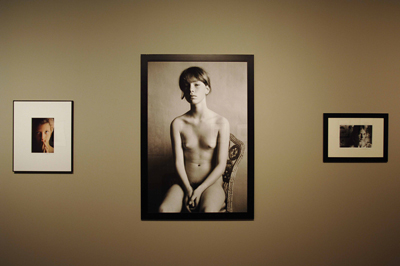
9/30/05

Hany Armanious

Ocular Lab
31 Pearson Street, Brunswick West, Melbourne, September 2005
hany-pic
Hany Armanious suggests that creativity, moments of change, all activity is a hot moment of friction then explosion. His sculpture Central Core Component from the Centre of the Universe models this combustion-reaction of new ideas. The sculpture is made of cast expander foam, cast pewter, polystyrene balls, carved and painted polystyrene pillars, a wax seat with candle, and a composite block of pepper corns. Like much of his work it intimates that alchemy and hallucination are essential. LSD, faith and hope are the beginning of all thought. It made me think, Is this how we generate an idea? Is this how the world explodes into being?
Rob McKenzie

9/29/05

Pawel Althamer

Bidibidobidiboo
Works from the Sandretto Re Rebaudengo Collection
via Modane 16 Turin, September 2005
Pawel_Althamere
Mentre mi accingo a scrivere queste righe su Pawel Althamer - nella speranza di farlo in fretta, in fondo sono state sollecitate dal fatto che la mia amica ha colto, durante una visita a una mostra, la semplice fascinazione che una sua opera ha esercitato su di me - ho sulla mia scrivania, per caso, il volume archive in motion 50 Jahre / Years documenta 1955-2005. 50 anni di arte e 50 anni di mostre, anzi della "mostra delle mostre", mi fanno pensare a questa scultura autoritratto di Althamer, nudo, la pelle raggrinzita e ingiallita, sul naso ancora - solo – i suoi occhiali. In relazione allo scorrere del tempo, al deteriorarsi degli elementi, all'invecchiamento di uomini e cose Althamer affronta il rapporto fra ciò che era e ciò che è. In relazione allo specifico dell'arte contemporanea, il rapporto fra opera, mostra e documentazione. L'opera di Althamer si inserisce in questi passaggi, però, come un adunaton logico, qualcosa di impossibile presentato come del tutto verosimile. L'opera, contemporanea, nasce vecchia, archeologica, da bacheca di museo (delle scienze post-atomiche). Nasce per confrontarsi con il suo stesso destino di testimonianza, con la sua collocazione tra spazio espositivo e documento d'archivio. E l'essere che raffigura appartiene a un tempo contratto (o dilatato) che suggerisce l'eterno, il dopo, o il prima. Nasce in viaggio nel tempo. Non è un caso che Althamer abbia partecipato proprio a documenta X come alieno in visita sulla terra.
Andrea Viliani

9/28/05

Nick Mangan

Gertrude Contemporary Art Spaces
200 Gertrude Street Fitzroy Melbourne, September 2005
Nick-Mangan-1
The Colony compiled a series of objects and each object a crowd of bits hewn from a variety of woods. Op-shop finds including polynesian-styled-souvenir-salad-spoons, pacific-islander-shop-trinketry, teak side-boards and knitting needles accompanied hardware store items such as axe and hammer handles. Nick collected the already-constructed and cut it out, and into, material. Each bit was frayed, as it entered into the collective; implying that everything is always coming undone, and at every instant. At moments, it seemed that the crafting which gave rise to the object-conglomerates might not be an activity entirely proportionate to the movements of a single maker; but instead arose from processes connected to some kind of multitudinous force of labour (such as the insistent holes that emerge from the mouths of a million termites, or centuries of embodied knowledge compressed into a technique like knitting). Even though we know this is not the case, the works obsessive-compulsive hyper-crafting solidified and then burst into symbolic resonance, so that something like the re-enactment or third-hand appropriation of the semi-archeological, semi-ethnographic, held sway. At first encounter, the work seemed to yearn for a nostalgic return to origins; in which notions of the authentic (of the real, the ritual) was sited, and fashioned within an aesthetic of ‘the tribal’. But this work implies a post-faux-neo-tribalism, or an appropriation of appropriations (and so on); of an authentic that never-ever existed. This work tells us the real is so very un-real and it lives in the crevices of a souvenir spoon, or a gallery floorboard, or wherever.
Bianca Hester

9/24/05

On Demand

The Centre of Attention
67 Clapton Common, London, September 2005
On Demand, works by Oreet Ashery, The Guerrilla Girls, Ben Morieson, Eileen Perrier, Markus Vater: You may select a work by one of the artists and arrange for the Centre of Attention to bring the selected work to your home. If you wish they will discuss it with you, and with your permission document it in the environment it is viewed in.
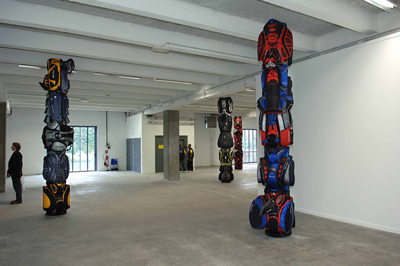
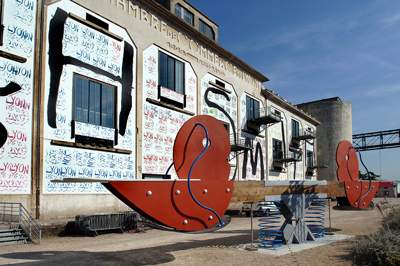
On-Demand
I volunteered for Markus Vater to visit my home. Usually I experience Art outside my flat. This was different I was letting Art in. Now the visit has been and gone and Markus has left me with a homemade bomb.
He arrived on his bike, his plinth, of course, in an IKEA bag courtesy of Gary and Pierre (from The Centre for Attention). Markus spoke of his seeking to explore the notion of taking a photograph, the belief that the photographic act steals a little part of the soul of the subject that becomes trapped forever in the image. Gone forever from the control or will of the subject. It seems apt to unpick this idea at a time when the line between gossip and fact has been blurred by surveillance and opportune digital evidence. Everyone is a reporter, a maker of opinion. Look I was there! It’s documentary evidence! It’s on my phone!
I thought Markus approached the series of poses he made, with the things in the flat and objects he brought with him, as a series of drawings, each mark (pose) inviting the next. Markus began the process by stealing a few bytes of light from the computer screen. He explored the space, he set up the shots, I colluded in the acts, I pressed the button, I took the image. My flat is awash with accumulated trash, retrieved proof of extravagant consumption, things that might still be recycled, repaired, maybe remade. I gave Markus carte blanche to move or use anything in the flat. Finally he separated a partly trashed alarm clock, battery exposed, he found some coiled BT wire and chose a couple of refilled water bottles. Somehow with his black tape they could become this other fearful object, and before he had left he'd made the bomb.
Elaina Arkeooll

On-Demand-bomb

9/16/05

Blakatak event #1

Museum of Contemporary Art, Circular Quay, Sydney
Saturday 17 September 2005 1.30 - 5.30 pm
Dominant doctrines of beauty: informing expectations of aesthetics in blak art practice and the market.
(click on the link above for more information, comments and discussion)

8/30/05

Is it really Graf?

Daze
An odd but perhaps telling thing happened the other day right in the middle of art world central: 22nd Street between 10th and 11th avenues in Manhattan, New York City. After a little haggling with our mayor, Michael Bloomberg (a good mayor who took up a silly cause on this effort), the “urban” fashion designer Mark Ecko staged a block party featuring graffiti writers painting on faux subway car sides.

Bloomberg claimed this event would encourage real vandalism. But the real coooky part is that Ecko is also the man behind “Getting Up: Contents Under Pressure, ” a video game coming out this fall for PS2, Xbox and PC. An ex-writer celebrating his past? Or, just a really good marketeer cashing in on nostalgia?

Though it was great to see artists like Henry Chalfant, Daze (who participated), my man Fab 5 Freddy and members of Tats Cru, the “legalized” block party had that new school corporate feel in spades. Hey, as a curator of one of the most recent museum exhibitions on hip hop, I can relate. At least this event was aimed to bring people to 22nd Street to see art, most of whom could care less about what hangs on the walls of the many galleries that dot one of the most important streets in the “art” world.
Franklin Sirmans
Lady Pink
top Daze this pic Lady Pink

8/26/05

Jota Castro

Uplands Gallery
Level 1/12 Waratah Place Melbourne, August 2005
Jota_Press_Image
The opening scene of Luchino Visconti’s 1954 film Senso famously opens in the Venice opera house with a scene from Verdi’s Il Trovatore. Death occurs on stage. The audience of occupying Austrians and fervent Italian patriots clash, but there are collaborators among them. The distance between opera and life is diminished.

Castro concentrates his video camera on a beautiful singer performing in a traditional salon setting. Elegance and passion in the performance; malice and irony in the text.

The Presidenzia Italiana, Berlusconi, is in fact heir to the collaboration of Mussolini and Hitler and the trasformismo that has marked Italian politics for at least two centuries.
Margaret Plant
visconti
Austrian soldiers at the Italian opera in Visconti's Senso,
see Lowe's comment

Domenico de Clario

A Second Simplicity
Australian Centre for Contemporary Art
111 Sturt Street Southbank Melbourne, August 2005
Dom-ACCA
Dom de Clario's walk-up apartment, shanty-built inside ACCA for the duration of the show, the rooms mimic his parent's little apartment in Trieste of the early 1950s. Very like Do-Ho Suh's recreations of his Korean family homes, similarly slightly but inintentionally creepy. Guests invited to lunch, one or two per day, homecooked by de Clario and his gentle, now elderly parents, the lunch conversation amplified out to the gallery visitors below via miked-up guests. The food was good but not too good, definitely simple. Conversation and lunch slated for one hour, which spun out to two. A little genteel, middle-class hesitancy at the start of the meal, formal introductions to de Clario's parents, whose presence throws the conversation off-course from art world gossip onto the food itself, and then onto food across the north of Italy. I'm reminded vaguely of the dinner-party conversation film genre, Bergman, French films, which neither guest wishes to puncture. I'm surprised by how little selfconsciousness is caused by sound amplification across the gallery beyond, more by the complication of the cross-generational guest mix and the charisma of de Clario's intensely intelligent, very beautiful mother (in her 70s, early 80s?), all of which leads into a focus on aging, on generational politics, on the bleakly self-censoring artworld, on the conceptual poverty of art school ecosystems. Before lunch, I guess I expected something of the ceremony of NYC-based artist Lee Mingwei's invitation-only events (to sleep with the artist, to have dinner with the artist, to accept money from the artist). I knew I didn't want to be part of a Linda Montano/Tehching Hsieh moment (tied together by a short rope for a whole year). I don't know how or if the lunches coalesced, but I suspect the result is more sociological - a portrait of the chattering class's anguish and aging - than an iconic collective image of community. If this is the case, then the work emerges quite differently to most of de Clario's recent performances and sculptures, for the sculpture/sculptor as avatar disappears.
Charles Green

8/23/05

Short ride in a fast machine

Gertrude Contemporary Art Spaces
200 Gertrude Street Fitzroy Melbourne, August 2005
ShortRideWeb
A Short Ride in a Fast Machine was designed to celebrate Gertrude Contemporary Art Spaces’ 20 year anniversary. A way to recognise the activity that has happened in the past and is still happening. There was a proposition of a history for the art space. Pure celebration and commemoration might have been better perspectives for understanding the show. With the publication that accompanied the exhibition, the simple question of who is visible and who is not was another central, though deferred, topic. Talk of vested interests and people left out stalked this exhibition.
Rob McKenzie
anonimo
Anonymous

8/21/05

The difference between you and me

The Ian Potter Museum of Art
University of Melbourne, August 2005
Odani
What a disappointing no thrills exhibition. It’s not so much the works in the show but the way they've been killed that’s the problem. Motohiko Odani’s video work Rompers, a post-nature/neo-genome rollick, might have created a lively ambience but is so tamely installed with the sound down ever so low. Lothar Hempel’s works look strangely unrelated to each other and rather than having a friction between the different use of materials they are flat and inactive. The Baselitz painting, borrowed from an Australian collection, seems to be the means by which to include the famous European artist. It’s David Noonan, Tracey Moffatt and Richard Larter’s works that add some verve to the show. And Larter’s works, in particular, are so good you want rub yourself on them. One goes to a show like this with every expectation it’s going to be good, especially given the gallery has been closed for maintenance for nearly two years. This show takes no risks and changes nothing.
Jacqueline Riva

8/16/05

The Beast With Three Backs

Lane Cormick Tony Garifalakis Matthew Griffin
Project Space RMIT
23-27 Cardigan St Carlton Melbourne, August 2005
Garifilakas
I find myself in front of work by Tony Garifilakis comprising a mass of framed pictures of faces; smashed, bloodied, chromed, brutalized. I catch myself in their spectacle, unable to remove myself from the imagery of fresh wounds. The faces are triumphant, defiant; moments of material made palpable. Then I wonder; who are these people? Where do they come from? By what circumstances has life inscribed itself upon them? They mock the specter of middle-class-ness. My banality.
Bianca Hester
matt-pic
see Griffin's comment

8/1/05

Brook Andrew

'Peace & Hope' Gabrielle Pizzi Gallery
Level 3, 75-77 Flinders Lane, Melbourne, July 2005
Brook-Andrew
Aboriginal boxer Anthony Mundine has been printed large on a poster. His image, chest and face, one bold signifier stretched out on the wall. Muscle, blackness, anger, pride, arrogance, violence, sport, identity, power, history. His image seems to provoke the discourses of contemporary Aboriginality. Mundine is both maligned and celebrated. A subject of conflict. On the internet I found something Mundine had written and it seemed to be what the image was saying, “I wasn’t outspoken and that back then. I didn’t have the confidence I have now.”.
Rob McKenzie
WinmarWilliams
see Lowe's comment related to these images
Brook-Andrew-02
see Ashley Crawford's comment

7/27/05

Colette

CK-Desert
Colette says everything with the utmost elegance and precision. In Cheri and The Last of Cheri, written towards the end of her career, Colette is consistently drop-dead funny in a social comedy kind of way, but her comedy is shaped into the most heart-rending, psychological depiction of the inevitabilities of estrangement, sadness, distance, age. Colette is Proust within a champagne bubble. The courtesans decorate their boudoirs in pink silk, read the financial trades, deal behind each other's backs in rubber futures. Colette, like the filmmaker Almodovar, loves and recognizes women as only a drag queen can.

Approaching 50, Lea, Cheri's heroine, is like a grown-up Claudine. Like Claudine in her adolescent omnipotence, Lea knows everything but, unable to keep her 25 year old lover from pursuing his own future, what good does knowledge do? With caustic grace, Lea becomes an earthy wise-cracking old woman, a parody of Colette's 19th century predecessor, George Sand. But each of Colette's scenes is perfect in its incandescence, and even more miraculous when read as parts of the whole: exquisitely positioned pieces of a larger narrative, cumulative and whole.

Here in Albuquerque, New Mexico, Colette is the muse de jour of all the local dykes. I sit on the bed in my one bedroom secretary condo reading her, when it's too hot to go outdoors.
Chris Kraus
Colette-Sleeping_Perf
see Lowe's comment about this image, Colette 'Real Dream (Sleeping Performance)' 1975

7/16/05

Kain Picken and Pat Foster

'As is' Clubs Project Inc
211 Gertrude Street Fitzroy Melbourne, July 2005
Kain-02
Kain Picken and Pat Foster made a show out of partially stolen IKEA products. There is an ‘As is’ section at IKEA which has broken, marked, scratched or remaindered goods. In the 'As is' section, prices are written on the item with a black felt tip marker. The artists took their own markers to IKEA, they said, 'We discovered that we could nominate our own prices'. Before the show opened though, they got caught. Kain Picken describes the situation, 'We’d been getting more ambitious about what we were getting, more expensive items, and we’d been going a couple of times a week. This one day we were kinda being blasé about it and getting a lot of stuff, and we aroused suspicion. We came back two days later and this big security guard guy came up to us and said, ‘Are you here to shop?’ and I said ‘Well of course I’m here to shop’. He said, ‘I’m not accusing you of anything, but you have to leave the store’.'

An exercise in how the artist might start to negotiate as the customer. As art and design interact with an expanded form of writing, it reveals a way for the consumer to speak through the object.
Rob McKenzie
How-Soap
see Lowe's comment related to these images
Ikea
see Morton's comment related to this image

7/14/05

Kate Fulton

'Panic Bolt' Studio 12
Gertrude Contemporary Art Spaces Melbourne, July 2005
Panic-Bolt-2
Walking into Kate Fulton’s work made the floor crack underfoot; it consisted of sheet-glass that had been installed over a singular electrical cord that ran the length of the work. The 4-or-so-mm of space opened up by the girth of the cord produced a little layer of space between the actual floor and the newly articulated glass surface, rendering it a horizontal zone engaged in a perpetual process of breakage with every foot of weight. Fulton’s work harnesses little energies and coagulates them together into something visceral. This particular work activates the ‘body’, staging it as a site for the co-mingling of energies. The body gets enveloped by and (almost erotically) involved with the greater force of the work. The work becomes a world that choreographs and registers the body, while in turn being inscribed by it.

On leaving, my clunky backpack came in close contact with one of the walls and they shuddered. I saw that these weren’t the walls that I’d already assumed them to be, but paper screens standing in as walls, waiting to be shredded to bits. This is the kind of work I love; it's always more, different, multiple; an event much greater than the will to know it.
Bianca Hester
snow-ice
see Kate Just's comment

6/29/05

Richard Grigg

Kings ARI
King Street Melbourne, June 2005
Richard Grigg
Richard has made a really thoughtful and intricate group of works. The space is dark and there are tiny battery operated globes that illuminate his objects and drawings. Pieces - legs, a bird with a cube for feet, a tree - are made from card stuck together and carved and sanded down with incredible detail and attention. And yet they are somehow also loose and the emphasis is not on the crafting of the objects but how they materialise and relate to the other things he's made and assembled. There is something not unfamiliar about this work but it's new somehow, perhaps it's the approach.
Jacqueline Riva

6/28/05

Ricky Swallow

'Killing Time' Australian Pavillion
Venice Biennale, June 2005
Ricky Swallow
I enjoyed Venice tremendously, especially so as I had been dreading going. After being sick the week before, I wasn't really in the mood for the artworld and the high powered schmoozing that is so much a part of Venice and so was pleasantly surprised that I really enjoyed the biennale. Ricky Swallow's work was great, but I felt that it seemed to mirror the Patricia Piccinini work in a weird way - perhaps in its meticulous hyper-reality - and came off badly for being presented in the same pavilion, as the sculptures were placed in almost the identical places as 2003, so that I felt a sense of deja vu. The work was beautiful; I just couldn't get away from thinking that they needed to have done something different in how they exhibited the work to break with the time before. The catalogue is fantastic, and very thoughtful.
Barbara Hunt

6/20/05

Lizzy Newman

Mir 11
11th Floor 522 Flinders Lane (Kings Carpark) Melbourne, May 2005
LNewman

Lizzy Newman's work was made for MIR11, but it seemed less concerned with the abstraction offered by art-space, and more interested in camping out in the concrete. The work presented itself up as an aggregate of furnishings, producing a doubly real and imaginary waiting room complete with water cooler. The supply of water was sucked completely dry by the time of the opening, and the fountain sat strangely empty for the duration of the show, kept company by a bin full of plastic cups at its foot. It imparted the work with a slightly depressing ambience, edged by lack, and absence; and of a dissapointment that you get when arriving too late.

Arresting the free-flow of sweaty couriers and well dressed architects between the ARM architectural offices and the lift well, the work hooked into the context of it’s foyer; creaming together the corporate with the abstract and offering itself up, almost masochistically, as a zone of service provision.

That the work was banished from the space, (without the artist's knowledge), by the ARM architects while hosting the arrival of “some important clients” (but replaced by a painting for the occasion!); convinces me of the potency of this work. It’s indeterminate nature worked to playfully unsettle, and activate the latent and forceful politics of its’ place.
Bianca Hester